Get to know the co-chairs for next April’s Scrum Gathering in San Diego.
This episode features Vic (@AgileCoffee) speaking agin with Kim Brainard (@agilebrain1). In July, the Scrum Alliance selected Kim and Vic to serve as co-chairs for next April’s Global Scrum Gathering in San Diego.
Say, have you gone to iTunes or Stitcher to give us a review? It takes so little time and would sure help us a lot. Thanks!
A 100% Skype-based episode! Vic is joined by Brett Palmer (@brett_palmer), Zach Bonaker (@ZachBonaker) and first-time guest Alan Dayley (@DayleyAgile).
Today our heroes discuss the following topics:
Is “Quality Assurance” an inhibitor to developing with agility?
Scenario: You are an experienced ScrumMaster just joining a new and dysfunctional team. What is your first goal?
“Falling off the cliff” scenarios
Common problem: The team does not update their progress on tasks and user stories in the electronic tool. So?
The Director says “Plan for more points in your next Sprints or we won’t get all this work done.”
Here in the USA, the summer travel season is heating up. Before you head off to exotic destinations, I want to let you know about a special opportunity right here in our area. Esther Derby and Don Gray are offering their outstanding workshop, Coaching Beyond the Team, in Costa Mesa, Sept 13 & 14. I feel this course will be invaluable for those of you in a scrum master or coaching role. The early bird price ends July 1. Details on the course below from Esther.
Have a great summer, Vic
Learn how to coach beyond the team
Agile coaches and Scrum Masters face many challenges. They have no authority to insist people listen or do, yet managers and executives expect organization-wide results from coaches’ activities. Managers have authority, but often need cooperation from others to achieve goals that cross reporting boundaries.
Discover the factors in the organization that are affecting your team’s ability to adapt to change and deliver value. Practice techniques to help others see how the environment is supporting or impeding your teams — and gain their cooperation to enhance productivity.
Through simulations and small group activities we’ll explore common organizational patterns and dynamics. By using discussion and practice, you’ll learn tools that will help you communicate the changes needed to unleash productivity.
When: September 13-14, 2016
Where: Costa Mesa, California
What: Two-days of interactive, experiential learning
Tuition: $1175 special friends and family price through July 1 $1295 regular price $1100 group price (limited to 4 from same organization)
Vic is joined by Zach Bonaker (@ZachBonaker) and Larry Lawhead (@LarryLawhead) at the Cape Rey in Carlsbad for a lively morning of Agile and Coffee.
In this episode, our Agile heroes discuss:
Eight-minute talks
Why companies lose Scrum focus
Power of Metaphor
What have you been reading lately?
Here’s the long list of books that Larry started and Zach and I added to:
The Toyota Way – by Jeffery Liker
The Toyota Way to Lean Leadership – by Jeffery Liker, Gary L. Convis
The Spirit of Kaizen – by Leigh Ann Hirschmann, Bob Mauer
The Lean Startup – by Eric Ries
Kanban: The Kanban Guide – by Paul VII
The Innovator’s Dilemma – by Clayton Christensen
The Wisdom of Crowds – by James Surowiecki
Leaders Eat Last – by Simon Sinek
The Five Dysfunctions of a Team – Patrick Lencioni
Coaching Agile Teams – Lyssa Adkins
The Art of Thought – Graham Wallas
Larry has also been viewing a lot of webinars in Scrum Inc’s “Scrum Lab” with his prime membership, but there is also a lot of stuff on their “Scrum Lab Open” (click “Online Learning”).
Reach out to Vic (@AgileCoffee) and use the hashtag #tellAgileCoffee to interact with us on an upcoming episode.
Recorded live from the Agile Open SoCal (Irvine, California), Victor (@AgileCoffee) is joined by three new guests: Aaron Griffith (@Aaron_Griffith), Colleen Kirtland (@CSKirtland) and Brock Nunn (@BANunn). In addition to general comments about the Open Space event, we also discuss:
Mob Programming and the Anti-Sprint Invasion
Were you surprised at the Agile Open?
The Importance of Culture and Behaviors in Agile
Agile for Social Betterment
If you missed the SoCal open space, consider attending Agile Open Northern California on October 9 & 10. More info at agileopencalifornia.com.
Victor (@AgileCoffee) participated in Scrum Day San Diego and interviewed a number of participants, including the winners of the Agile San Diego usergroup’s annual Agile Awards. Congratulations to Joe Dailey (winner of the Agilist of the Year, 2014) and to ID Analytics (recipient of the 2014 Agile San Diego Team Excellence Award). Also Dr. Dave Cornelius (@DrCorneliusInfo) and his son, Dave, accepted a gift on behalf of the 5Saturdays initiative which introduces Scrum to high school students.
Over 100 Scrum enthusiasts gathered on June 12th, 2015 in San Diego County to advance their understanding on how to launch Agile projects successfully. The theme of this second annual Scrum Day was “Well Begun is Half Done”, and featured speakers included Tirrell Payton, Marcelo Fernandez, Lauren Feehrer and Niv Genchel. Diana Larsen delevered a powerful keynote address on the topic of Lift-Offs and Agile Chartering, and a panel moderated by conference organizer Carlton Nettleton fielded questions from participants.
Back in March I led a pair coaching workshop at Scrum Day Orange County 2015. My goal with the session was to examine a few pair-coaching roles, share a list of competency areas for Scrum Masters, and use dominoes to demonstrate viable situations where pairing will help the coach, her team, or the larger organization.
No matter how good we are, we still can’t learn or do everything on our own. Whether you’re a Scrum Master, product owner or other member in an Agile workplace, you should consider using pair-coaching to raise your skill level, create positive change on your teams and improve relationships throughout the organization.
When I was approached to make a presentation on pair-coaching, I began asking around for comments. It was important to me that participants left with something tangible and valuable. I began building the content as a powerpoint deck, but early feedback (and my post-lunch time slot) suggested an interactive workshop made more sense.
Roles in Pair-Coaching
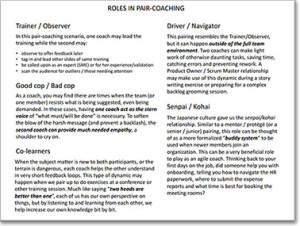
The goal of the workshop was to get participants thinking in terms of the many ways to use pair-coaching at the workplace. To do this, it was important to share the five pairing roles that I previously discussed:
Trainer / Observer
Driver / Navigator
Yin / Yang (I’ve renamed this role from “Good Cop / Bad Cop”)
Kohai / Sempai
Co-Learners
By introducing the five roles, I was able to give specific contexts in which to imagine using pair-coaching. (The handout above offers a summary of the five roles.)
* I owe much to Yves Hanoulle, a true creative collaboration agent, for his work identifying most of these roles (I am really just mucking with them). Yves has been a strong proponent of pair-coaching for many years, and most of the research I do on the subject turns up his name.
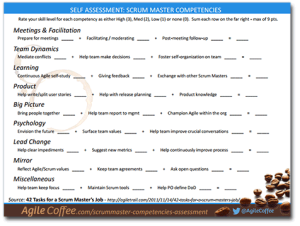
This assessment I put together was taken primarily from Bernd’s list of 42 tasks, though I overlaid the “grading” rubric to meet the needs of this game. (A big thanks to Fabrice Aimetti for translating this into french: Evaluation des compétences du Scrum Master.)
In the workshop, I ask the participants to give themselves a grade for each competency – from “0” equating to “no experience” to “3” meaning “expert”. They can sum the numbers across each row (competency group) to gauge what areas of coaching they’re good at and which could use improvement. (The point isn’t to be too critical here, but to have some grounding for the game.) The range of row-scores is zero (0) to nine (9), identical to the range of numbers on my dominoes.
Rules of the Game
Finally we get to the game itself. Each participant has a double-nine domino tile at their seat when they come in the room. They are asked to match one of their numbers to pair with another participant – this is done to get them out of their chairs and meet “random” people in the room. Example, if my domino has a two (2) and a five (5), I find another person with either of those digits.
When they form pairs (eg. both have a five (5) on their domino), they assume expertise levels based on the other number not used to match up. In my two and five scenario, I would use two (2) as my expertise level because I used the five (5) to meet another five. (It’s a pain to explain, but participants caught on quickly.)
Each pair then talks through a case of which roles they might play for a hypothetical scenario. For example, if a “two” (novice) is paired with an “eight” (expert), they might play out a Driver / Navigator situation. If the numbers are close but low (eg, 3 & 2), the scenario might be Co-Learners; and a 7 & 9 combo may yield a Good Cop / Bad Cop storyline.
Let me say that this early iteration of the game could certainly use some adjustment. I’m open to feedback even to the point of removing the dominoes altogether. Having said that, however, it seemed to work very well to stimulate role-playing and discussion in the workshop. So… success!
Below is a video of the session. The workshop begins by reviewing the five roles, and we start playing with dominoes approximately 22 minutes into the video. I am again grateful to Scott Dunn of Rocket Nine Solutions for the support, and to Cliff Rosa of Rosa Media Productions for the recording – thanks to you both!
I hope that you try this game and I welcome feedback in the comments here on this page or to me on Twitter at @AgileCoffee. Best of luck in your pairing!
To share an abundance of topics, Victor is joined by Dale Ellis (@theDigitalDale), Larry Lawhead (@LarryLawhead), Jon Jorgensen (@waterScrumBan) and Dr. Dave Cornelius (@DrCorneliusInfo) in the Irvine studio for a lively morning of Agile and Coffee.
We’re at a crossroads, and you can help! Is this format working for you? How can we improve upon it? AND – what ideas do you have for recording the sessions over the interwebs? Would you like to join one? Let Vic know by twitter or email.
Mark your calendars for Dr. Dave’s 5 Saturdays program’s Train the Facilitators workshops: May 30th and June 6th. More info at 5Saturdays.org
Reach out to Vic (@AgileCoffee) on Twitter and use the hashtag #tellAgileCoffee to interact with us on an upcoming episode.