scrum

  • 36. Lessons from 5Saturdays Students

    astancia_castOn July 25th, another successful 5Saturdays program wrapped up at Estancia HS in Costa Mesa, CA, and twelve students shared their takeaways with me on the podcast. These high-school-aged participants talked about the lessons learned over their five weekend sessions, focusing on job readiness and effective communications.

    Topics discussed include:

    • applications of creative thinking
    • tools for critical thinking
    • facets of agility using Scrum
    • resume-building and interviewing skills
    Recording setup in the library of Astancia HS
    Our setup in the library of Estancia HS

    One central theme that students spoke of was their interest in using personal kanban in their everyday lives, having recognized its ease and usefulness in planning.

    I was happy to have met and talked with these students. They each agreed that they found high utility in the five-week course, and their understanding and appreciation of Scrum and Agile concepts was immediately apparent in our conversation.

    I want to once again thank all student participants and wish them the best of luck as they finish their high school journeys armed with this new knowledge and unique experience.


    Have you heard about the Agile Coffee decks of cards? We’ve assembled the best and most-popular topics from our podcasts and local meetups, and we created two decks of casino-quality playing cards. These decks are helpful for groups wanting start their own lean coffee meetups, or for anyone with a desire to start conversations. Visit our kickstarter page before Sept 24 to become a backer, and stop by agilecoachingcards.com to see some nifty photos and find out more about these and other decks.

    Reach out to Vic (@AgileCoffee) on Twitter and use the hashtag #tellAgileCoffee to interact with us on an upcoming episode.

  • 34. Transparency as a Tool to Build Trust

    Victor is joined by Dale Ellis (@theDigitalDale) and Larry Lawhead (@LarryLawhead) on a beautiful SoCal morning for Agile and Coffee.

    In this episode, our Agile heroes discuss:

    • Limits to transperency
    • Project reporting (is the Burndown enough?)
    • Mandated documentation in Agile
    • Project definition phase
    • Getting teams to behave like teams
    • Engaging the non-participative team member

    Reach out to Vic (@AgileCoffee) on Twitter and use the hashtag #tellAgileCoffee to interact with us on an upcoming episode.

  • 32. Scrum Day San Diego 2015

    Victor (@AgileCoffee) participated in Scrum Day San Diego and interviewed a number of participants, including the winners of the Agile San Diego usergroup’s annual Agile Awards. Congratulations to Joe Dailey (winner of the Agilist of the Year, 2014) and to ID Analytics (recipient of the 2014 Agile San Diego Team Excellence Award). Also Dr. Dave Cornelius (@DrCorneliusInfo) and his son, Dave, accepted a gift on behalf of the 5Saturdays initiative which introduces Scrum to high school students.

    Over 100 Scrum enthusiasts gathered on June 12th, 2015 in San Diego County to advance their understanding on how to launch Agile projects successfully. The theme of this second annual Scrum Day was “Well Begun is Half Done”, and featured speakers included Tirrell Payton, Marcelo Fernandez, Lauren Feehrer and Niv Genchel. Diana Larsen delevered a powerful keynote address on the topic of Lift-Offs and Agile Chartering, and a panel moderated by conference organizer Carlton Nettleton fielded questions from participants.

    For more information on that event, visit scrumdaysandiego.com

    • Zach Bonaker (@ZachBonaker), Brett Palmer (@Brett_Palmer) & Vic discuss the value of Scrum Day
    • Zach talks about entering into, guaging success of, and gracefully exiting coaching engagements
    • Vic asks the Dave Corneliuses (both of them) about the honorarium awarded to 5Saturdays
    • Members from ID Analytics, the Agilist Team of 2014, share their path to success with Scrum
    • Joe Dailey, recipient of Agilist of 2014, discusses his successes in the workplace and the community

    – – – –

    Coming up in episode 33 – lean coffee from Scrum Alliance’s Scrum Coaching Retreat in Seattle.

  • What is a ScrumMaster?

    In addition to our regular podcasts, I host a couple lean coffee meetups every month where we get people dropping in who are less experienced yet very curious about Agile methodologies and lean principles. One common theme at these in-person sessions centers around the role of a ScrumMaster, and it’s a topic that engages us old-timers just as much.

    Many of us have been serving as ScrumMaster of our teams, but the job description changes for every workplace and every team. For this reason, I trust the responses from my peers; still, we’re often left with more questions than “correct” answers. Here are a few of the questions with some of my observations.

    What is a ScrumMaster?

    There are many good starts at a definition, but I like Mike Cohn’s for its succinctness:

    The ScrumMaster is responsible for making sure a Scrum team lives by the values and practices of Scrum. The ScrumMaster is often considered a coach for the team, helping the team do the best work it possibly can. The ScrumMaster can also be thought of as a process owner for the team, creating a balance with the project’s key stakeholder, who is referred to as the product owner.

    One key responsibility of the ScrumMaster is to protect the team from outside interruptions, requests that could potentially derail the team’s focus and increase its work in process (WIP). In this way, the SM is like a sheepdog guarding the flock. In fact, Ken Schwaber uses this analogy often, saying it’s the SM’s role to keep the wolves away.

    Another aspect to the role is to remove impediments, and the best ScrumMasters are those who have the technical or political know-how to recognize a roadblock early and see that it gets removed. Speed and tact are two skills that they brandish, skills that improve the more they are yielded.

    Does a ScrumMaster need to be dedicated to the role 100% of their time?

    The saying is that a good ScrumMaster can take on two-to-three teams, but a great ScrumMaster can only handle one. There’s room to have a debate on this question, but my feeling is that if you’re working with only one team and you find yourself with too much idle time, you may not be looking hard enough. Either that, or the team is mature enough to no longer require a full time ScrumMaster.

    Michael James, in his erudite article at the Scum Alliance’s site, fairly well states this case. He spells out no fewer than 42 items for a ScrumMaster to keep on her checklist. Incidentally, 42 is the same number on Bernd Schiffer’s similarly excellent post on a ScrumMaster’s job (be sure to check out the comments – GOLD!) Maybe 42 really is the answer to life, the universe and everything.
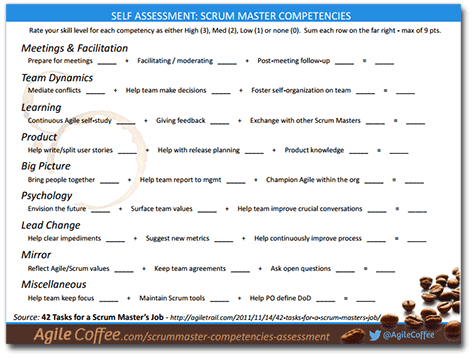
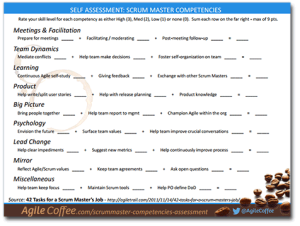
    ScrumMaster competencies assessmentI find both these lists comprehensive and extremely useful when discussing the work of the ScrumMaster. In fact, I built my own assessment primarily from Bernd’s article. (Merci beaucoup to Fabrice Aimetti for translating the document into french: Evaluation des compétences du Scrum Master.)

    If you can honestly say that you’re scoring eights or nines across each of the rows on the assessment, then maybe you are working yourself out of a job. (That is the goal, after all.) It’s likely that your team has benefited to the point that they are mature enough for you to look for another team to lend a helping hand. Which leads nicely to the next question…

    Can another member of the team also be an effective SM?

    My own opinion is “Sure, why not?” If the team member – and the team – are willing to try it, I wouldn’t discourage this automatically. It ultimately depends on the maturity of the team and the willingness of one contributor to give of himself to serve others. But keep in mind: if the ScrumMaster is committing to work in the sprint, their bandwidth (and motivation) to help clear impediments or pick up other responsibilities (eg. evangelize Agile outside of the team) is at a substantial disadvantage.

    I was a coach in an organization that did encourage team members to try their hand at scrummastering (albeit, out of necessity at first). It’s a great way not only to cross train new skills, but also to strengthen the Agile culture within an organization. Just make sure that everyone is on board with the decision – it should never be forced upon a team member. (I still believe that a dedicated SM trumps anyone who is splitting their time with multiple duties.)

    Does the ScrumMaster need to be technically proficient with the software stack?

    I don’t believe the SM needs be technical at all. They can maintain a “beginner’s mind”. It helps to have someone who is terrifically unbiased in many situations – especially if they’re focused on guarding the process. That eliminates a potential conflict of interest.

    On the other hand, some familiarity with the technology can help when clearing impediments. Anticipating the needs of the team based on historical relationships with the ADLC are certainly valuable.

    But the argument can be made that being too knowledgeable is bad because then the SM would be tempted to inject herself into discussions of how, and this could lead to (or be interpreted as) dictating to the team what or how to do their work. Smells of micromanagement arise.

    Do they need to understand the product inside and out?

    Similar to the need to be technically adept, is it important for SMs to be experts on the product they’re delivering? Again, I can see two sides to the debate. On one hand, that’s the role of the Product Owner, and being completely free of bias can prove to be a large advantage for the otherwise engaged ScrumMaster.

    However, everywhere I’ve worked as a ScrumMaster or coach, I realized tremendous value in understanding the product at a moderately deep level. It helped (again) anticipate needs for communication and dependencies, and the PO usually appreciated having someone to back her up from time to time.

    So, as they say, “try it – you might like it.”

    What other characteristics make an effective ScrumMaster?

    One of the most powerful traits is courage. Call it “having kajones” or simply “being comfortable in delivering the message”, this skill sets the effective Scrum Master apart from the many who just go “by the book”. However, willingness alone will not get you there; to be most effective you must also possess a large amount of tact. Being able to deliver news without alienating your audience is critical. (As Ken Schwaber reminds us, “a dead sheepdog is a useless sheepdog“.)

    So don’t be afraid to step onto the soapbox. It’s not “un-Agile”. In fact, it’s not only appropriate, but demanded. Remember that you’re more empowered than you think.

    Situational leadership is a related skill to be mindful of. By speaking up and identifying that the team is off track, you can provide solutions; but always remember that team needs to own them. When team is too dependent on the ScrumMaster, that could be a learning experience. Maybe the SM should walk away and let the team figure out the path out of the woods.

    One final characteristic I’ll mention is to be a continual learner. Our landscape is always changing, and we need to keep abreast of the ebbs and flows. By continuously checking our own orientation, we can become more trusted to guide the team through changes and challenges.

    Additional Resources

    Don’t just take my word for it. As I said, sometimes there are no right answers – that’s why we continue to have the conversations at the lean coffee meetups. And here’s a list of pretty good opinions, well worth checking out to help inform your own opinion:
  • The Pair-Coaching Domino Game

    domino-game
    Back in March I led a pair coaching workshop at Scrum Day Orange County 2015.  My goal with the session was to examine a few pair-coaching roles, share a list of competency areas for Scrum Masters, and use dominoes to demonstrate viable situations where pairing will help the coach, her team, or the larger organization.

    (You may remember that I enjoy exploring this topic, and that I wrote about it earlier in the year. It seems that I’ll be talking about more this summer at the Scrum Alliance Coaching Retreat, possibly at the Agile Open SoCal and certainly at Agile SoCal in November.)

    No matter how good we are, we still can’t learn or do everything on our own. Whether you’re a Scrum Master, product owner or other member in an Agile workplace, you should consider using pair-coaching to raise your skill level, create positive change on your teams and improve relationships throughout the organization.

    When I was approached to make a presentation on pair-coaching, I began asking around for comments. It was important to me that participants left with something tangible and valuable. I began building the content as a powerpoint deck, but early feedback (and my post-lunch time slot) suggested an interactive workshop made more sense.

    Roles in Pair-Coaching

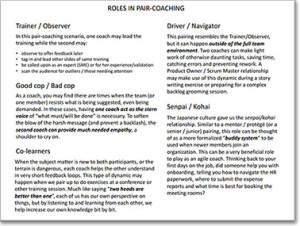
    Roles in Pair-CoachingThe goal of the workshop was to get participants thinking in terms of the many ways to use pair-coaching at the workplace. To do this, it was important to share the five pairing roles that I previously discussed:

    • Trainer / Observer
    • Driver / Navigator
    • Yin / Yang (I’ve renamed this role from “Good Cop / Bad Cop”)
    • Kohai / Sempai
    • Co-Learners

    By introducing the five roles, I was able to give specific contexts in which to imagine using pair-coaching. (The handout above offers a summary of the five roles.)

    * I owe much to Yves Hanoulle, a true creative collaboration agent, for his work identifying most of these roles (I am really just mucking with them). Yves has been a strong proponent of pair-coaching for many years, and most of the research I do on the subject turns up his name.

    ScrumMaster Assessment

    While I’m giving credit to others who deserve it much more than me, I’d like to call your attention to Bernd Schiffer’s excellent article on the 42 Tasks of a Scrum Master’s job. I find his list quite comprehensive and very useful when talking about pair-coaching.

    ScrumMaster competencies assessmentThis assessment I put together was taken primarily from Bernd’s list of 42 tasks, though I overlaid the “grading” rubric to meet the needs of this game. (A big thanks to Fabrice Aimetti for translating this into french: Evaluation des compétences du Scrum Master.)

    In the workshop, I ask the participants to give themselves a grade for each competency – from “0” equating to “no experience” to “3” meaning “expert”. They can sum the numbers across each row (competency group) to gauge what areas of coaching they’re good at and which could use improvement. (The point isn’t to be too critical here, but to have some grounding for the game.) The range of row-scores is zero (0) to nine (9), identical to the range of numbers on my dominoes.

    Rules of the Game

    Finally we get to the game itself. Each participant has a double-nine domino tile at their seat when they come in the room. They are asked to match one of their numbers to pair with another participant – this is done to get them out of their chairs and meet “random” people in the room. Example, if my domino has a two (2) and a five (5), I find another person with either of those digits.

    When they form pairs (eg. both have a five (5) on their domino), they assume expertise levels based on the other number not used to match up. In my two and five scenario, I would use two (2) as my expertise level because I used the five (5) to meet another five. (It’s a pain to explain, but participants caught on quickly.)

    Each pair then talks through a case of which roles they might play for a hypothetical scenario. For example, if a “two” (novice) is paired with an “eight” (expert), they might play out a Driver / Navigator situation. If the numbers are close but low (eg, 3 & 2), the scenario might be Co-Learners; and a 7 & 9 combo may yield a Good Cop / Bad Cop storyline.

    Let me say that this early iteration of the game could certainly use some adjustment. I’m open to feedback even to the point of removing the dominoes altogether. Having said that, however, it seemed to work very well to stimulate role-playing and discussion in the workshop. So… success!

    Below is a video of the session. The workshop begins by reviewing the five roles, and we start playing with dominoes approximately 22 minutes into the video. I am again grateful to Scott Dunn of Rocket Nine Solutions for the support, and to Cliff Rosa of Rosa Media Productions for the recording – thanks to you both!

    I hope that you try this game and I welcome feedback in the comments here on this page or to me on Twitter at @AgileCoffee. Best of luck in your pairing!

  • 28. “Agile” Under the Microscope

    Victor is joined by Dale Ellis (@theDigitalDale), Jason Kerney (@JasonKerney), Zach Bonaker (@ZachBonaker) and Garrett Borunda (LinkedIn) at the Cape Rey in Carlsbad for a lively morning of Agile and Coffee.

    In this episode, our Agile heroes discuss:

    ACCUSWest 2015 archive at AgileLib.net, courtesy of Tobias Mayer

    Coming soon is Dr. Dave‘s 5 Saturdays program’s Train the Facilitators workshops: May 30th and June 6th. More info at 5Saturdays.org

    Reach out to Vic (@AgileCoffee) on Twitter and use the hashtag #tellAgileCoffee to interact with us on an upcoming episode.

  • 25. Agile Planning and User Story Mapping

    Vic is joined by Brett Palmer (@brett_palmer) and Larry Lawhead (@LarryLawhead) for a lively morning of Agile and coffee.

    Today our heroes discuss the following topics:

    • Agile Planning – discussed WSJF and Donald Reinertsen’s book “The Principles of Product Development Flow”
    • User Story Mapping
    • Roles in pair-coaching
    • Servant Leadership

    AgileGathering.com has the info about our upcoming Agile Coach Camp US West, April 10-12, 2015

  • 24. How to Budget for Agile Software Development

    Vic is joined by Brett Palmer (@brett_palmer), Jon Jorgensen (@waterscrumban) and Larry Lawhead (@LarryLawhead) for a lively morning of Agile and coffee.

    Today our heroes discuss the following topics:

    • Agile Budgeting – Larry lent his copy of Agile Estimating and Planning to his CEO. Will he get it back?
    • The power of Standing for Agile – getting the team to arise
    • Mike Lavery (@baconPhilosophy) asks about tips for moderating the initial Product Backlog meeting
    • Framework Regression pain – when can a team create a circle of excellence?

    Want more? Visit our brand new forums on the AgileCoffee website.

    AgileGathering.com has the info about our upcoming Agile Coach Camp US West, April 10-12, 2015

  • 23. We Discuss a Listener’s Topic!!

    Vic is joined by Dale Ellis (@thedigitaldale), Dr. Dave Cornelius (@DrCorneliusInfo) and Larry Lawhead (@LarryLawhead) for a lively morning of Agile and coffee.

    Today our heroes discuss the following topics:


    Want more? Visit our brand new forums on the AgileCoffee website.

    AgileGathering.com has the info about our upcoming Agile Coach Camp US West, April 10-12, 2015

  • 12. Three Amigos or the Dirty Dozen?

    A fresh brew: Vic is joined by Jon Jorgensen (@waterScrumBan) and Brett Palmer (@Brett_Palmer) for another morning of Agile and Coffee.

    In this episode, our heroes discuss the following topics:

    1. pre-review of “Scrum: The Art of Doing Twice the Work in Half the Time”, Jeff Sutherland’s upcoming book from Crown Publishing.
      • we’ll be holding a review of the book in an upcoming episode, including book giveaways – stay tuned
      • how does this book relate to Joy, Drive Collaboration Explained and Tribal Leadership?
    2. Nerf Gun Economy
    3. Proximity Switch Estimating, with Lasers
      • a tool for estimation on par with planning poker
    4. the (upcoming) Agile Open of Southern California

    Reach out to Vic (@AgileCoffee) on Twitter –  and use the hashtags #askAgileCoffee or #tellAgileCoffee to interact with us on an upcoming episode.