agile

  • 35. It’s a CROSSOVER! Agile Coffee for Humans

    Victor is joined by Jon Jorgensen (@waterScrumBan) and Ryan Ripley (@RyanRipley) of the excellent Agile for Humans podcast for a double-sized, ultra packed episode of Agile Coffee for Humans.

    In this episode, our Agile heroes discuss:

    • The HR Side of Agile – Performance Reviews, Raises, & Transparency
    • The Business of Agile – How we justify the investment in agility
    • Ken’s Complaint -Trademarking Scrum Group
    • Crossing the line – push and pulling hair
    • Organisational Psychotherapist, the new coach – a reflection on Bob Marshall’s Why Me?
    • Agile Transformation – The REST of the story (like Paul Harvey)
    • Agile games, simulations and learning activities – see my post on games

    Holding Space article by Heather Plett

    book: Crucial Conversations by Patterson, et al

    Reach out to Vic (@AgileCoffee) on Twitter and use the hashtag #tellAgileCoffee to interact with us on an upcoming episode.

  • 34. Transparency as a Tool to Build Trust

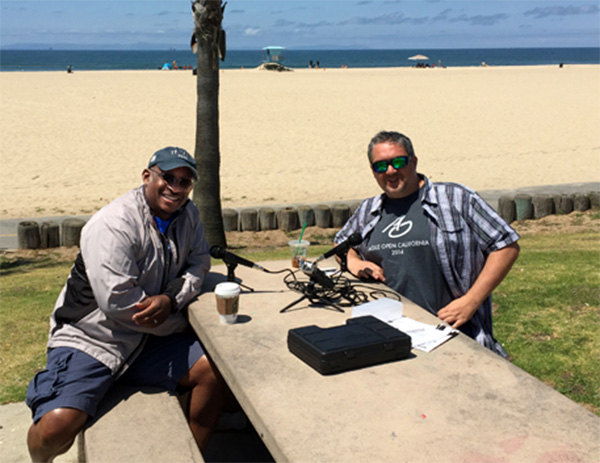
    Victor is joined by Dale Ellis (@theDigitalDale) and Larry Lawhead (@LarryLawhead) on a beautiful SoCal morning for Agile and Coffee.

    In this episode, our Agile heroes discuss:

    • Limits to transperency
    • Project reporting (is the Burndown enough?)
    • Mandated documentation in Agile
    • Project definition phase
    • Getting teams to behave like teams
    • Engaging the non-participative team member

    Reach out to Vic (@AgileCoffee) on Twitter and use the hashtag #tellAgileCoffee to interact with us on an upcoming episode.

  • 33. Scrum Coaching Retreat Seattle

    Lean Coffee recorded in Seattle, June 24, 2015

    Vic (@AgileCoffee) attended the Scrum Alliance’s fourth Scrum Coaching Retreat in the USA. It was three days of examination of what it means to be a coach in a scrum environment and how we can improve our coaching methods worldwide.

    In the first two days, participants had the opportunity to pitch a project they wished to focus on. Everyone then joined a project team and organized using scrum processes and roles. We had three sprints (spanning the two days) in which to iterate and increment on a delivery of our final products. The final day was devoted to an Open Space event and a closing retrospective.

    One of the projects created can be found at AgileLeadershipToolkit.com. I’ll make others available once I receive explicit permission and links from their creators.

    Special kudos go out to Stewart Young (@Stuartliveart) of illustrationstation.co.uk for completing some amazing artwork throughout the three days.

    Vic hosted a lean coffee during Open space on the third day, and he was joined by:

    Topics included:

    • Overcoming team dysfunctions at the Scrum Coaching Retreat
    • Alternative formats for a three-day retreat
    • How to do podcasts (see below)
    • PO coaching beyond the basics
    • Impact Mapping
    • Value proposition for coaching vs just training

    For more information on retreats

    Links to previous (and upcoming) Coaching Retreats in the USA:

    1. Boulder, CO – Dec 7-9, 2011
    2. Chandler, AZ – Dec 4-6, 2013archive of projects
    3. Raleigh (Chapel Hill), NC – Oct 28-30, 2014
    4. Seattle, WA – June 22-24, 2015
    5. Irvine, CA – Spring 2016

    Podcasting Tools and Techniques

    I produce my shows old school – by gathering participants in a room and recording with a bunch of mics. (I have a degree in audio engineering, so I’m a bit of an audiophile.) It’s fun, and nothing beats the face-to-face communication with all its nuances and clarity. We meet about twice a month in a mostly quiet space, and it takes my about 10-15 minutes to set up the equipment and do a quick check of levels.

    For these bigger on location recording (from 4 to 6 attendees), I use a Behringer X1222 mixing board and Audio Technica ATR2100 or similar mics, plug it into my laptop and be good. [None of these links are affiliate links – just plain links to Amazon.] When it’s only a few of us, I’ll just bring my Zoom H5 handy recorder to blug mics in to – no need to lug my laptop around. In my home studio where it’s only me, I either plug my mic into the laptop or go through a smaller Behringer Xenyx mixer.

    For post-production I use the free software Audacity (for PC). It does everything I need; I only do a minor amount of editing, and I like to tweak the levels somewhat. I export the file as MPEG Layer 3 (.mp3) format and load it into my local iTunes to enter the metadata (pretty much just cut-and-paste from a template). Then it’s time to upload to my audio host. Libsyn costs about $12 / month, but you can get a cheaper plan with them (or free elsewhere) if you podcast less frequently (I post at least two Agile Coffee podcasts a month and sometimes other projects as well). Libsyn also provides download stats. When it’s time to announce the new episode, the Blubrry PowerPress plugin (free) to my WordPress site does the heavy lifting by submitting the feed to iTunes & Stitcher as well as embedding an audio player on the post’s page.

    Here are some of the Agile-themed podcasts I consume:

    That’s it. Hit me up with questions at @AgileCoffee.

  • Keeping busy between jobs

    Being out of work is a blessing and a curse. On one hand, having long stretches of time to focus thoughts and efforts on pet projects and learning is amazing. With clear vision and consistent effort, one can make tremendous progress in achieving high-value goals. On the other hand, you’re still out of a job.

    The search could surely be going better – summer vacations really slow down the hiring process – but it’s at least moving, giving me hope that I’ll land in a great spot. And on the plus side, I’d already planned to have some time off this summer, so I had a bit of savings put aside. Once I became free, I let my inner circle know of my availability and began sending out my updated resume.

    Once this transition from the old chapter begins, I’m able to focus not only on my new career goals, but also make a dent in real and actionable work to “sharpen my saw”. As you review my progress, reflect on your own methods and projects. I’d love to hear what others things passionate agilistas do to make positive strides in their personal and professional growth.

    What I’m doing with my time

    Blogging – My first priority has been to give attention to my own personal blog. I’m not a very consistent writer, and I’m not extremely confident in the voice or style I employ, so I set an aggressive goal of one post a week. Now nine weeks without work, I’ve produced enough posts (this being number eight) to be pretty close to that aspiration. For me, posts are reflections of my working philosophy and summaries of experiences I’ve had on the job. They allow me to inspect and prepare to adapt my approaches to coaching and working with teams. As of this writing, I’ve got another eight posts pending – some started as drafts, others mere ideas on a backlog.

    Product Development – The Lean Coffee Starter Deck is another important project I’d had in mind for a while. I’ve been hosting local meetups twice a month for over three years, with little downtime. Since the earliest sessions, I’ve kept a running list of all topics the groups brought up. As you can imagine, there’s quite a lot of repeated questions over the three years, so I affinity-grouped these and created two decks (54 pre-printed cards each) of the most popular topics. I’m preparing to put together a kickstarter campaign (just need to finalize a nice video), but you can have a sneak peak here (link).

    Reading – What’s a summer without some good reading? I now begin (after morning meditation) and end most days with a chapter or three from either my long-ignored pile of books or one of the many new selections I recently acquired. I’m currently juggling Reinventing organizations (Laloux) and Leadership Agility (Joiner and Josephs), and I’ve already finished off quite a stack: Essentialism (McKeown), No Asshole Rule (Sutton), Three Pillars of Agile Quality & Testing (Galen), Management 3.0 (Appelo) and Art of Agile Development (Shore). In the queue is Fritjof Capra, Kent Beck, Peter Senge, Ron Jeffries and a few others. (I do my best to model reading to my nine-year-old, but she’s having none of it; instead enjoying her summer break surrounded by her little pony toys.)

    Volunteering – A few activities (gratis) to keep me insanely busy but also connected to actual humans. First, I’d presented a lunch-and-learn at the L.A. office of TEKsystems in June. An hour of Agile and Scrum to a roomful of recruiters – hopefully I did some good to the world of job-seekers. Next, I’m once again helping organize the Agile Open Southern California (link). If you’ve attended in the past three years, those new emails you’re receiving are from me. (You’re welcome!) I’ll be pulling other duties for AOSC as well, perhaps holding space alongside Diana and others. Finally, I show up at a number of Dr. Dave Cornelius’ 5Saturdays (link) events to share techniques of Lean Coffee and other goodness with high school kids and their adult instructors. Good times.

    Podcasting – Of course there’s still the Agile Coffee Podcast to maintain. We’re up to episode 32 published to iTunes and Stitcher, and I’ve got three more recorded and in the editing pipeline. This project is among my most self-fulfilling as I get to talk with passionate agile minds about topics of great interest. I average a new 45-minute episode posted every two weeks with no signs of abating – so please subscribe and rate us on iTunes. And holy cow, WOW, I was recently interviewed by Ryan Ripley on his Agile for Humans podcast, episode 8 (link). Ryan’s show has quickly become one of my faves (I listen to many other terrific Agile shows), so it was quite the honor to appear with him there. (And guess what? Look for an Agile Coffee for Humans crossover in the near future.)

    Industry Events – Back in June I participated in two great affairs: Scrum Day San Diego (link) and Scrum Alliance’s Scrum Coaching Retreat (link). Compelling voices and good friends gathered in by the waterfront in San Diego, and I talked with many Scrum heroes there for podcast episode 32 (link). The retreat in Seattle was a particularly rewarding and welcomed opportunity to escape the grind of the home office and meet truly awesome people. The project team I joined was engaged in building out a Coaching Dojo, an undertaking that made great use of research that I’m doing in the area of pair-coaching. Teammates were engaging, and they inspired me to raise my game. What more could you ask for?

    What’s next for me?

    It’s hard to deny that I’m keeping busy. I feel that I’m striking a good balance between personal/professional development and community involvement. I believe in the value of giving, and I’m grateful for all I get in return. Still, I feel driven to do more. There are a few presentations (link) I want to revise or develop, plus a couple videos I’d like to produce. Then there’s the kickstarter project I mentioned – really stoked about creating card decks to help coaches, scrum masters and other agilists create conversations. And I have an idea for another podcast, one focused narrowly on the topic of servant leadership.

    Is it enough? I can’t answer that. No one can. But it certainly gives me new experiences to discuss in the future. And focusing on self-improvement keeps me from sinking into a victim-like mindset of pity and self-loathing. It helps give me confidence to have honest conversations with colleagues and potential employers, unashamed of the duration between engagements.

    I’m curious to hear what others do in times like this. Leave a comment below or hit me up on twitter (@AgileCoffee). What keeps you busy improving? How do you sharpen your saw?

  • Agile games, simulations and learning activities

    A colleague approached me recently with a request. He was about to meet with a new division of his company and lead transformation activities at the team level, so he wanted advice on the best agile games to include. As usual, I turned my advice into a blog post so that (hopefully) others can benefit from my experiences.

    We all know that games are fun and that humans are hard-wired to play. Like most coaches, I use games, simulations and other learning activities fairly liberally in my engagements, but I want to be clear: I never play games just to play games. There has to be a need for taking an activity out of my toolbox and introducing it to the team.

    Activities that get us out of our chairs are generally good. The body moves around and gets blood up to our brains. It gives us a chance to get away from the book-fed material and internalize the lessons. All good points, but still we often sell the benefit of game-play short to say something like “this section of the training material is dry, so let’s put a game here”.

    Including a game or simulation should be thought of as a “teeing up” of the learning objective. Another way to say it: the game creates an effective canvas for painting the picture. It prepares the learners to “get” the message. Just as I wouldn’t force a game into my curriculum for the sake of having a game, I also wouldn’t ignore the opportunity to reinforce the training objective with a valid learning activity.

    My favorite games for teaching lean and agile concepts

    Before I share my list, a quick word on terms. (Credit goes to Derek Wade @derekwwade for this description in the Google group: Agile Games)

    • Learning Activity – Exercises that engage people, helping them reach a conclusions and assist in learning (thereby increasing performance).
    • Problem-Based Learning – Learning activities which require participants to solve problem relating to a specific subject.
    • Simulation – A problem-based learning activity that has components which cognitively mirrors the environment, methods, problems and practices of the learning domain.
    • Game – A simulation which has rules of play to either win/lose (finite game) or to keep the game in play (infinite game).

    Jargon aside, here’s a list of games:

    • Buy a Feature – Teaches feature prioritization
      • Best played in groups of 3-8. Takes 10-15 minutes.
      • Each player receives two items: (1) a handout with a menu of features and their prices (2) a sum of play money. (Features can be anything: items to have on a vacation, goals of a two-day training, benefits of a high-functioning team, etc.) The play money should contain a variety of denominations. The sum total of all players’ money should be less than the total of all feature prices – this introduces scarcity and forces the team to make trade-offs because it’s not possible to purchase all items on the list.
      • Players take turns using their individual sums of money to but the features they deem most valuable. Once players have spent most of their funds (either they don’t have enough individually to make another purchase or they don’t value what’s left on the menu to buy anything else), the group will pool the remaining funds and discuss what to buy from the remaining items.


    • Human Knot [ link to example video ]- Teaches self-organization
      • Best played in groups of 6-20. Takes about 2-3 minutes per round, including instructions.
      • Start with all players standing to form a large circle, facing inside the circle. Everyone moves in close (shoulder-to-shoulder) and reaches their left hand into the mix, grabbing the left hand of another player (not their immediate neighbor). Next, reach in the right hands and grab a new person’s right hand (again, not the neighbor next to you).
      • While keeping all hands connected, the group then proceeds to twist and turn out of the scrambled knot they’ve formed. After a minute or more, the group should once again return to a large circle of people clasping hands.
      • Remember: Safety first. If someone is getting squeezed or about to trip, it’s better to release a hand or two tham to end up with broken bones or sprained thingies.
      • It’s fun if two or more groups of equal number compete to see who can “untie” themselves first.


    • Multitasking [ link ] – Shows how multi-tasking reduces effectiveness.
      • Played individually at a table or whiteboard. Playing two rounds takes less than 5 minutes.
      • Each player needs one sheet of paper (or on a whiteboard) and something to write with. It’s best if they each have their own stopwatch (phone, duh), but the facilitator can monitor time for the group if necessary.
      • The paper will have three blank columns to be filled in, and the task is the same for each of two rounds. Column one will contain the letters A thru J; column two lists the digits 1 thru 10; column three will have roman numerals I thru X. All finished columns should contain their ten elements in their proper order.
      • The difference between the two rounds comes in how the columns get filled out. in round one, players must write one letter, followed by one digit, followed by one roman numeral, then repeat. In round two, players should write all letters first, before moving on to the digits, and filling in the roman numerals last.
      • Each of the two rounds is timed, and we see that the multitasking of round one consumes a greater time than the focused task completion of round two.


    • Pair-Origami (link) – Illustrates the importance of face-to-face (vs. distributed) communication.
      • Need total of six or more players. Takes about 10-15 minutes.
      • Divide the players into three groups (A, B & C). Players for pairs in each group. Each pair consists of a folder and a PO (product owner) or manager. All folders get a single sheet of 8.5×11 paper, and each PO/manager receives an instruction page (download link).
        • Players in group A sit side-by-side. Only the folder player may fold the origami, but both partners may see the instruction sheet.
        • Players in group B sit face-to-face. Only the folder player may fold the origami. The PO/manager may give feedback but may not show the instructions to the folder.
        • Players in group C sit back-to-back. Only the folder player may fold the origami. The PO/manager may read/explain the instructions to the folder but may not see the origami as it’s being folded.
      • When the timer starts, all pairs get to work. When a pair completes their origami, their time gets recorded. The facilitator may (mercifully) call time when it’s apparent that pairs in group C are about to explode.


    • Penny Flip game (link) – Emphasizes value of small batches and process improvement.
      • Teams of 8-10 gathered around a table. Four rounds of play takes about 20-25 minutes.
      • Need a roll of pennies (other coins or cards may be substituted)
      • (more description coming soon)


    • Ball Point game (link) – Teaches teamwork and process improvements.
      • One large team (bigger is better – up to 30 is okay). Four or five rounds of play takes about 15-20 minutes.
      • Need 20-50 balls (balled-up paper works okay) and a large, open space for team to move around.
      • (more description coming soon)


    These are just a few links to a tiny percentage of games available. For many more activities, I recommend joining the aforementioned Google group: Agile Games as well as visiting some of the great sites that aggregate these invaluable learning activities (eg. TastyCupcakes.org).

  • 32. Scrum Day San Diego 2015

    Victor (@AgileCoffee) participated in Scrum Day San Diego and interviewed a number of participants, including the winners of the Agile San Diego usergroup’s annual Agile Awards. Congratulations to Joe Dailey (winner of the Agilist of the Year, 2014) and to ID Analytics (recipient of the 2014 Agile San Diego Team Excellence Award). Also Dr. Dave Cornelius (@DrCorneliusInfo) and his son, Dave, accepted a gift on behalf of the 5Saturdays initiative which introduces Scrum to high school students.

    Over 100 Scrum enthusiasts gathered on June 12th, 2015 in San Diego County to advance their understanding on how to launch Agile projects successfully. The theme of this second annual Scrum Day was “Well Begun is Half Done”, and featured speakers included Tirrell Payton, Marcelo Fernandez, Lauren Feehrer and Niv Genchel. Diana Larsen delevered a powerful keynote address on the topic of Lift-Offs and Agile Chartering, and a panel moderated by conference organizer Carlton Nettleton fielded questions from participants.

    For more information on that event, visit scrumdaysandiego.com

    • Zach Bonaker (@ZachBonaker), Brett Palmer (@Brett_Palmer) & Vic discuss the value of Scrum Day
    • Zach talks about entering into, guaging success of, and gracefully exiting coaching engagements
    • Vic asks the Dave Corneliuses (both of them) about the honorarium awarded to 5Saturdays
    • Members from ID Analytics, the Agilist Team of 2014, share their path to success with Scrum
    • Joe Dailey, recipient of Agilist of 2014, discusses his successes in the workplace and the community

    – – – –

    Coming up in episode 33 – lean coffee from Scrum Alliance’s Scrum Coaching Retreat in Seattle.

  • 31. Lean Coffee at the 5Saturdays

    Lean Coffee at the 5Saturdays

    Vic (@AgileCoffee) stops by Dr. Dave’s (@DrCorneliusInfo) 5Saturdays event to introduce lean coffee to a large group of facilitators-in-training.

    Guests include: Evelyn Crofts, Keith Montgomery, Curtis Gilbert, Seth Silvernail, Jon Jorgensen, Angela Rong Sun, Robbie Smith, Purnima Vaidyanathan, Valarmathy Rangasamy and Joe Dailey.

    Topics:

    • Planning & executing tasks in the household
    • Velocity-based vs. Capacity-based planning
    • Agile sneak attacks in waterfall environments
    • Showstoppers identified in daily scrum
    • Reflection on day #2 of 5Saturdays’ Train the Facilitator

    – – – –

    Coming up in episode 32 – interviews from the 2nd annual Scrum Day San Diego.

    Further ahead in episode 33 – lean coffee from Scrum Alliance’s Scrum Coaching Retreat in Seattle.

  • What is a ScrumMaster?

    In addition to our regular podcasts, I host a couple lean coffee meetups every month where we get people dropping in who are less experienced yet very curious about Agile methodologies and lean principles. One common theme at these in-person sessions centers around the role of a ScrumMaster, and it’s a topic that engages us old-timers just as much.

    Many of us have been serving as ScrumMaster of our teams, but the job description changes for every workplace and every team. For this reason, I trust the responses from my peers; still, we’re often left with more questions than “correct” answers. Here are a few of the questions with some of my observations.

    What is a ScrumMaster?

    There are many good starts at a definition, but I like Mike Cohn’s for its succinctness:

    The ScrumMaster is responsible for making sure a Scrum team lives by the values and practices of Scrum. The ScrumMaster is often considered a coach for the team, helping the team do the best work it possibly can. The ScrumMaster can also be thought of as a process owner for the team, creating a balance with the project’s key stakeholder, who is referred to as the product owner.

    One key responsibility of the ScrumMaster is to protect the team from outside interruptions, requests that could potentially derail the team’s focus and increase its work in process (WIP). In this way, the SM is like a sheepdog guarding the flock. In fact, Ken Schwaber uses this analogy often, saying it’s the SM’s role to keep the wolves away.

    Another aspect to the role is to remove impediments, and the best ScrumMasters are those who have the technical or political know-how to recognize a roadblock early and see that it gets removed. Speed and tact are two skills that they brandish, skills that improve the more they are yielded.

    Does a ScrumMaster need to be dedicated to the role 100% of their time?

    The saying is that a good ScrumMaster can take on two-to-three teams, but a great ScrumMaster can only handle one. There’s room to have a debate on this question, but my feeling is that if you’re working with only one team and you find yourself with too much idle time, you may not be looking hard enough. Either that, or the team is mature enough to no longer require a full time ScrumMaster.

    Michael James, in his erudite article at the Scum Alliance’s site, fairly well states this case. He spells out no fewer than 42 items for a ScrumMaster to keep on her checklist. Incidentally, 42 is the same number on Bernd Schiffer’s similarly excellent post on a ScrumMaster’s job (be sure to check out the comments – GOLD!) Maybe 42 really is the answer to life, the universe and everything.
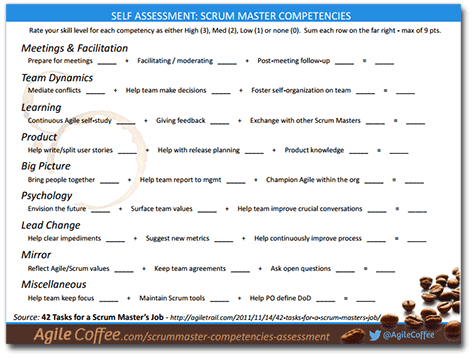
    ScrumMaster competencies assessmentI find both these lists comprehensive and extremely useful when discussing the work of the ScrumMaster. In fact, I built my own assessment primarily from Bernd’s article. (Merci beaucoup to Fabrice Aimetti for translating the document into french: Evaluation des compétences du Scrum Master.)

    If you can honestly say that you’re scoring eights or nines across each of the rows on the assessment, then maybe you are working yourself out of a job. (That is the goal, after all.) It’s likely that your team has benefited to the point that they are mature enough for you to look for another team to lend a helping hand. Which leads nicely to the next question…

    Can another member of the team also be an effective SM?

    My own opinion is “Sure, why not?” If the team member – and the team – are willing to try it, I wouldn’t discourage this automatically. It ultimately depends on the maturity of the team and the willingness of one contributor to give of himself to serve others. But keep in mind: if the ScrumMaster is committing to work in the sprint, their bandwidth (and motivation) to help clear impediments or pick up other responsibilities (eg. evangelize Agile outside of the team) is at a substantial disadvantage.

    I was a coach in an organization that did encourage team members to try their hand at scrummastering (albeit, out of necessity at first). It’s a great way not only to cross train new skills, but also to strengthen the Agile culture within an organization. Just make sure that everyone is on board with the decision – it should never be forced upon a team member. (I still believe that a dedicated SM trumps anyone who is splitting their time with multiple duties.)

    Does the ScrumMaster need to be technically proficient with the software stack?

    I don’t believe the SM needs be technical at all. They can maintain a “beginner’s mind”. It helps to have someone who is terrifically unbiased in many situations – especially if they’re focused on guarding the process. That eliminates a potential conflict of interest.

    On the other hand, some familiarity with the technology can help when clearing impediments. Anticipating the needs of the team based on historical relationships with the ADLC are certainly valuable.

    But the argument can be made that being too knowledgeable is bad because then the SM would be tempted to inject herself into discussions of how, and this could lead to (or be interpreted as) dictating to the team what or how to do their work. Smells of micromanagement arise.

    Do they need to understand the product inside and out?

    Similar to the need to be technically adept, is it important for SMs to be experts on the product they’re delivering? Again, I can see two sides to the debate. On one hand, that’s the role of the Product Owner, and being completely free of bias can prove to be a large advantage for the otherwise engaged ScrumMaster.

    However, everywhere I’ve worked as a ScrumMaster or coach, I realized tremendous value in understanding the product at a moderately deep level. It helped (again) anticipate needs for communication and dependencies, and the PO usually appreciated having someone to back her up from time to time.

    So, as they say, “try it – you might like it.”

    What other characteristics make an effective ScrumMaster?

    One of the most powerful traits is courage. Call it “having kajones” or simply “being comfortable in delivering the message”, this skill sets the effective Scrum Master apart from the many who just go “by the book”. However, willingness alone will not get you there; to be most effective you must also possess a large amount of tact. Being able to deliver news without alienating your audience is critical. (As Ken Schwaber reminds us, “a dead sheepdog is a useless sheepdog“.)

    So don’t be afraid to step onto the soapbox. It’s not “un-Agile”. In fact, it’s not only appropriate, but demanded. Remember that you’re more empowered than you think.

    Situational leadership is a related skill to be mindful of. By speaking up and identifying that the team is off track, you can provide solutions; but always remember that team needs to own them. When team is too dependent on the ScrumMaster, that could be a learning experience. Maybe the SM should walk away and let the team figure out the path out of the woods.

    One final characteristic I’ll mention is to be a continual learner. Our landscape is always changing, and we need to keep abreast of the ebbs and flows. By continuously checking our own orientation, we can become more trusted to guide the team through changes and challenges.

    Additional Resources

    Don’t just take my word for it. As I said, sometimes there are no right answers – that’s why we continue to have the conversations at the lean coffee meetups. And here’s a list of pretty good opinions, well worth checking out to help inform your own opinion:

  • The Pair-Coaching Domino Game

    domino-game
    Back in March I led a pair coaching workshop at Scrum Day Orange County 2015.  My goal with the session was to examine a few pair-coaching roles, share a list of competency areas for Scrum Masters, and use dominoes to demonstrate viable situations where pairing will help the coach, her team, or the larger organization.

    (You may remember that I enjoy exploring this topic, and that I wrote about it earlier in the year. It seems that I’ll be talking about more this summer at the Scrum Alliance Coaching Retreat, possibly at the Agile Open SoCal and certainly at Agile SoCal in November.)

    No matter how good we are, we still can’t learn or do everything on our own. Whether you’re a Scrum Master, product owner or other member in an Agile workplace, you should consider using pair-coaching to raise your skill level, create positive change on your teams and improve relationships throughout the organization.

    When I was approached to make a presentation on pair-coaching, I began asking around for comments. It was important to me that participants left with something tangible and valuable. I began building the content as a powerpoint deck, but early feedback (and my post-lunch time slot) suggested an interactive workshop made more sense.

    Roles in Pair-Coaching

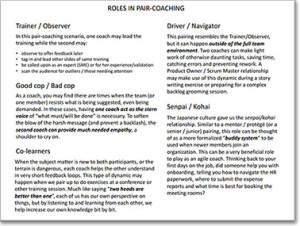
    Roles in Pair-CoachingThe goal of the workshop was to get participants thinking in terms of the many ways to use pair-coaching at the workplace. To do this, it was important to share the five pairing roles that I previously discussed:

    • Trainer / Observer
    • Driver / Navigator
    • Yin / Yang (I’ve renamed this role from “Good Cop / Bad Cop”)
    • Kohai / Sempai
    • Co-Learners

    By introducing the five roles, I was able to give specific contexts in which to imagine using pair-coaching. (The handout above offers a summary of the five roles.)

    * I owe much to Yves Hanoulle, a true creative collaboration agent, for his work identifying most of these roles (I am really just mucking with them). Yves has been a strong proponent of pair-coaching for many years, and most of the research I do on the subject turns up his name.

    ScrumMaster Assessment

    While I’m giving credit to others who deserve it much more than me, I’d like to call your attention to Bernd Schiffer’s excellent article on the 42 Tasks of a Scrum Master’s job. I find his list quite comprehensive and very useful when talking about pair-coaching.

    ScrumMaster competencies assessmentThis assessment I put together was taken primarily from Bernd’s list of 42 tasks, though I overlaid the “grading” rubric to meet the needs of this game. (A big thanks to Fabrice Aimetti for translating this into french: Evaluation des compétences du Scrum Master.)

    In the workshop, I ask the participants to give themselves a grade for each competency – from “0” equating to “no experience” to “3” meaning “expert”. They can sum the numbers across each row (competency group) to gauge what areas of coaching they’re good at and which could use improvement. (The point isn’t to be too critical here, but to have some grounding for the game.) The range of row-scores is zero (0) to nine (9), identical to the range of numbers on my dominoes.

    Rules of the Game

    Finally we get to the game itself. Each participant has a double-nine domino tile at their seat when they come in the room. They are asked to match one of their numbers to pair with another participant – this is done to get them out of their chairs and meet “random” people in the room. Example, if my domino has a two (2) and a five (5), I find another person with either of those digits.

    When they form pairs (eg. both have a five (5) on their domino), they assume expertise levels based on the other number not used to match up. In my two and five scenario, I would use two (2) as my expertise level because I used the five (5) to meet another five. (It’s a pain to explain, but participants caught on quickly.)

    Each pair then talks through a case of which roles they might play for a hypothetical scenario. For example, if a “two” (novice) is paired with an “eight” (expert), they might play out a Driver / Navigator situation. If the numbers are close but low (eg, 3 & 2), the scenario might be Co-Learners; and a 7 & 9 combo may yield a Good Cop / Bad Cop storyline.

    Let me say that this early iteration of the game could certainly use some adjustment. I’m open to feedback even to the point of removing the dominoes altogether. Having said that, however, it seemed to work very well to stimulate role-playing and discussion in the workshop. So… success!

    Below is a video of the session. The workshop begins by reviewing the five roles, and we start playing with dominoes approximately 22 minutes into the video. I am again grateful to Scott Dunn of Rocket Nine Solutions for the support, and to Cliff Rosa of Rosa Media Productions for the recording – thanks to you both!

    I hope that you try this game and I welcome feedback in the comments here on this page or to me on Twitter at @AgileCoffee. Best of luck in your pairing!

  • 30. Agile Community Events on the Beach

    Theme: Agile Community Events

    on the beach with Dr. DaveDr. Dave (@DrCorneliusInfo) joins Vic (@AgileCoffee) for a beautiful morning on Huntington Beach discussing all manner of Agile community events: Agile Opens (and other open space uses), coaching retreats and camps, lean coffees, hackathons. Dave talks about the 5Saturdays model, and we tell how to find, get involved and host these activities.

    This is one of my favorite episodes. In addition to the excellent scenery and the superb company, I very much enjoy talking about community events. Not only do I believe that community is important and fulfilling, but I have a penchant for organizing these activities.

    For more information

    Open Space:

    Agile Opens:

    Agile Coach Camps:

    Scrum Coaching Retreat Seattle 2015

    LeanCoffee.org – includes listing of cities with lean coffees

    5Saturdays.org – Dr.Dave’s community learning initiative to bring Scrum and other skills into local high schools

    • ALICE – educational software that teaches computer programming in a 3D environment

    Scrum Day San Diego and Scrum Day Orange County (Vic presented at both in each of their first years)

    various others:

    Finally, Vic ran a couple of Hackathons in the workplace…

    – – – –

    Coming up in episode 31 – I hold a lean coffee at a 5Saturdays event with a cast of new voices.

    Further ahead in episode 32 – interviews from the 2nd annual Scrum Day San Diego.