meetups

  • 11. The Art of Throwing Ice Water on Reality

    Vic (recently iced) is joined by Jon Jorgensen (@waterScrumBan) and Brett Palmer (@Brett_Palmer) for another morning of Agile and Coffee.

    In this episode, our Agile heroes discuss the following topics:

    1. ALS Ice Bucket Challenge – Jon and Vic both participated. Vic’s video is here.
    2. pre-review of Jeff Sutherland’s new book Scrum: the Art of Doing Twice the Work in Half the Time
    3. Wall Walks with chairs
    4. Fresh Training and Book Updates
    5. Fantasy Football Draft parallels to Agile/Lean

    Reach out to Vic (@AgileCoffee) on Twitter –  and use the hashtags #askAgileCoffee or #tellAgileCoffee to interact with us on an upcoming episode.

  • 5. Creativity in Agile? Use Your Imagination

    Live from Paradise Perks, Dr. Dave Cornelius (@DrCorneliusInfo) and Arielle Caron join Jon and Vic use the lean coffee format to discuss the following topics:
    1. XScale
    2. Kill Agile
    3. koans, problem solving and goose in a bottle
    4. brainstorming / inceptions … worthwhile?
    5. Creative Inc’s model of brainstorming
    6. Greenhousing and Jesse’s Lasso

    Reach out to Jon (@waterScrumBan) and Vic (@AgileCoffee) on Twitter –  and use the hashtags #askAgileCoffee or #tellAgileCoffee to interact with us on an upcoming episode.

  • 4. Coffee is Done When it’s Done

    Live from Paradise Perks, Jon and Vic use the lean coffee format to discuss the following topics:

    • Agile Games and Gamification
    • Agile in Japan
      • referenced The New New Product Development Game by Takeuchi and Nonaka, 1986
    • Training, Taboos and Readiness
    • Recursion: Use it or Lose it
      • Jim McCarthy (Software for your Head, the Booted, etc.)
      • Jon brought up the movie Ed Wood starring Johnny Depp, but I thought he said “Elwood” and completely missed the reference – lol
    • Big Plan Up Front (BPUF) vs Just In Time (JIT) plans vs No plans
      • does no plan = no estimates?

    Please reach out to Jon (@waterScrumBan) and Vic (@AgileCoffee) on Twitter –  and use the hashtags #askAgileCoffee or #tellAgileCoffee to interact with us on an upcoming episode.

    Here are some upcoming Agile/Lean events in California and across the USA:

    • Scrum Day San Diego – June 13
      • Interact with local executives, ask why they went with Scrum and Agile and hear the benefits they received from this new way of working.
    • Agile2014 – Orlando, FL — July 31 – Aug 1
      • AgileAlliance’s annual conference will reinforce our understanding of proven methods and will illuminate some of the exciting new innovations that represent the future of Agile.
    • Agile Open Southern California 2014 – Irvine, CA — Sept 11-12
      • Join experienced Agile practitioners and newcomers alike for two days to discuss, examine and otherwise brainstorm the most timely and relevant topics in Agile development today.
  • 3. Lean Coffee for Two: Minimally Viable Agile

    Vic (@AgileCoffee) and Jon use the lean coffee format to discuss the following topics:

      • Minimally Viable Agile
      • Transparency between POs, SMs and teams
      • Non-IT Agile
      • Safe environments and the Soup

    Plus we take a look ahead to the following agile/lean events both in California and across the USA:

    • Scrum Day San Diego – June 13
      • Interact with local executives, ask why they went with Scrum and Agile and hear the benefits they received from this new way of working.
    • Agile2014 – Orlando, FL — July 31 – Aug 1
      • AgileAlliance’s annual conference will reinforce our understanding of proven methods and will illuminate some of the exciting new innovations that represent the future of Agile.
    • Agile Open Southern California 2014 – Irvine, CA — Sept 11-12
      • Join experienced Agile practitioners and newcomers alike for two days to discuss, examine and otherwise brainstorm the most timely and relevant topics in Agile development today.
  • 2. We’re Here and We’re Motivated

    In this second episode of Agile Coffee podcast, Vic (@AgileCoffee) is joined by Jon and they use the lean coffee format to discuss the following topics:

      1. what motivates people
      2. making a difference
      3. body of work
      4. coddling teams
      5. are we overly idealistic?
      6. 50 new Agile coaches hired

    We mention the following books:

    Plus we take a look ahead to the following agile/lean events both in California and across the USA:

    • Scrum Day San Diego – June 13
      • Interact with local executives, ask why they went with Scrum and Agile and hear the benefits they received from this new way of working.
    • Global SCRUM Gathering ® – New Orleans — May 5-7
      • Scrum Alliance’s annual gathering in the USA will showcase the powerful “goodness” that Scrum can bring to our products, our professional relationships, our workplaces, and our organizations.
    • Agile2014 – Orlando, FL — July 31 – Aug 1
      • AgileAlliance’s annual conference will reinforce our understanding of proven methods and will illuminate some of the exciting new innovations that represent the future of Agile.
    • Agile Open Southern California 2014 – Irvine, CA — Sept 11-12
      • Join experienced Agile practitioners and newcomers alike for two days to discuss, examine and otherwise brainstorm the most timely and relevant topics in Agile development today.
  • 20 Questions

    Agilists are everywhere.

    We come in all stripes.

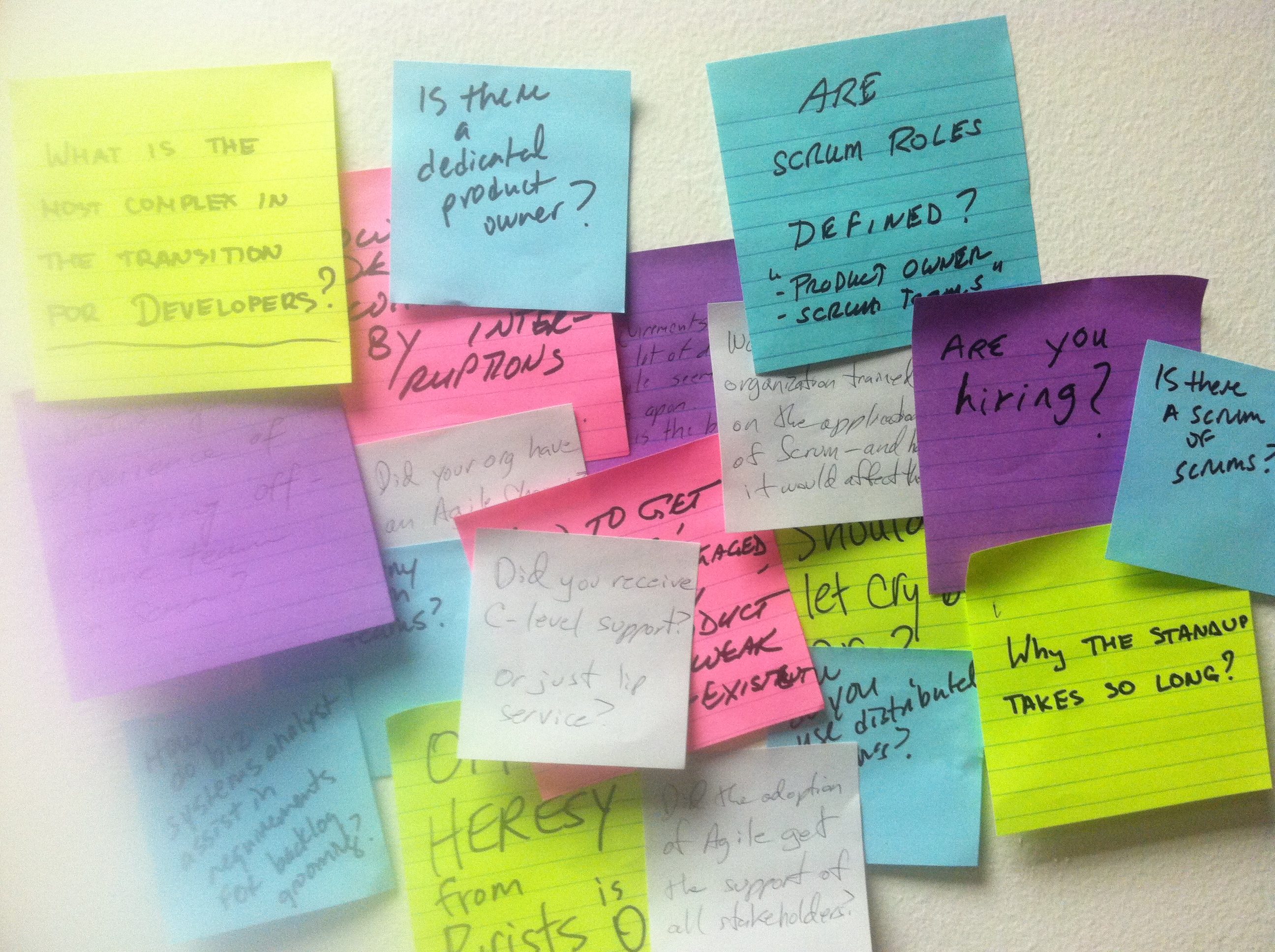
    Combine these two observations and you realize that at any time the opportunity can present itself to broaden your perspective on Agile practices.  When we meet other practitioners, it’s routine to ask a few basic questions; but if we take a disciplined approach to our inquiry, the encounter becomes a powerful learning experience for both parties – and one that frames the shared memory of the relationship’s inception.

    20 Questions

    I’ve recently come up with a list of 20 questions. The list isn’t static – it changes often. The questions themselves can range from the standard (team size, iteration length) to the unexpected (do you allow whining?), and I try to include one or two fun questions to make this exercise not seem like… well, an ‘exercise’.

    Here’s a partial list focused on the day-to-day:

    • How many teams do you work with?
    • What are the sizes of the teams?
    • Are Scrum roles defined?
    • What’s the iteration length?
    • Has there been an Agile champion in senior management from the beginning?
    • Is there a dedicated Product Owner (PO)?
    • How do you deal with drive-by interruptions?
    • Was the entire organization trained on the application of Scrum and how it would affect them?
    • Have you considered Kanban?
    • How do you balance between features that require a lot of details and delivering just enough just in time?
    • Are your teams co-located? If not, how do you collaborate with distributed teams?
    • Was the exec team on board with Agile adoption, or how did they otherwise buy-in?
    • Is there a scrum of scrums?
    • How do you show results to C-levels and keep them engaged?
    • Do you integrate regular Hackathons or Dev Days?

    I’ll also ask a few personal improvement questions:

    • Where do you see yourself in 3,5,10 years? (What drives you?)
    • Are there any trainings/books/podcasts/conferences would you recommend?
    • What have you learned from your mistakes?
    • How are you involved in your community?
    • What person/people do you know that I should get introduced to?

    Again, the point is not to interrogate these poor souls that you just met. I’m certainly not advocating that you read off this list and ask every question. Save that for the job interview 😉 Rather, I’m suggesting to use a few questions like these to not only break the ice, but to fast-track a sharing of your own views and experiences with the goal of reaching a broader understanding of who we are as agilists.

  • presenting “Agile for Start-ups: SG’s History with Agile”

    In November I presented at SoCal Code Camp (USC) on the topic of my company’s history with Agile (from start-up to 200+ employees and 160B emails). It was my first time to present this topic, and it was tailored for an audience without much Agile experience.

    (For those interested, here’s a link to the slides: http://www.slideshare.net/VictorBonacci/agile-for-startups-sendgrids-history-with-agile-2013-bonacci# (If you’re interested, you can also view the full hour-long presentation here: http://www.screencast.com/t/WNwufLDPh01)

    In December I presented the topic again, this time to a roomful of practitioners at Agile San Diego. The audience there gave terrific feedback, including questions such as:

    • which metrics were introduced when? to what effect (efficacy)?
    • did metrics allow members/teams to game the system? which metrics?
    • what were some of the most impactful experiments we did with the processes?
    • how often did we experiment?
    • how did we measure results of experimentation?
    • was there an ebb/flow to the buy-in at the executive level?
    • do we use data to move people between teams?
    • how do we measure efficacy of pair-programming?
    • does our Agile adoption contribute to morale or turnover?

    The answers to these questions will make there way into the next iteration of the presentation, tentatively scheduled for an upcoming Agile SoCal event in Irvine. Meanwhile, I’ll discuss this at my AgileCoffee meetups and post notes here as they roll in.

  • LeanCoffee in Ohio

    Just got back from a relatively relaxing Thanksgiving pilgrimage to Ohio for family and football. While there I hopped over to Starbucks to host a LeanCoffee in Ohio (I’d posted it on Meetup a few weeks prior).

    As I’d expected, attendance was nil. Not sure if that speaks more to the fact it was a holiday weekend or that Ohioans don’t use meetup. I ruled out there being no love for Agile/Lean, for within a couple minutes of sitting there with my post-its and sharpies, the guy next to me (Robert) started asking me what I had? We talked about the setup and meetup a bit before getting to Agile. His company (hospital linens servicer) uses Lean principles to operate, and his brother works in an Agile shop (UI / Design).

    Alive and well in Twinsburg, Ohio.

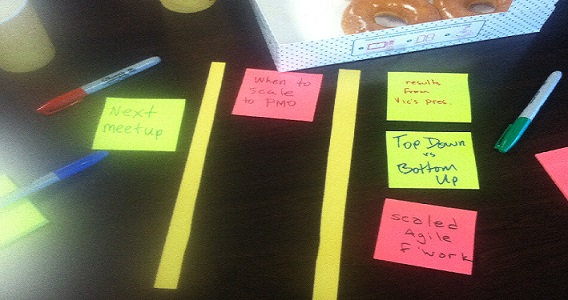
    an example session at Starbucks
    an example session at Starbucks, with doughnuts!!
  • Scaling Me, Scaling You

    I just scheduled our next meetup and threw these two questions out:

    • How many teams is too many for one roving scrummaster?
    • How many members before a team is too large?

    What’s great is that the group can discuss / debate the question. Despite being in Scrum environments for over six years, I don’t have THE answer, but I DO have some opinions based on solid experiences.

    Without playing too much of my hand prior to the actual meet-up, here’s what I’m thinking:

    Roving ScrumMaster

    I was hired here at SendGrid as an Agile Coach tasked with leading the transformation and maintaining the learning and culture that goes along with that. One year into my job here, we had nine teams located between Anaheim (five), Boulder (three) and Romania (one); and for most of that year, each dev team provided its own scrum master. I and another coach (Stuart joined us in January, 2012) would coach the teams, paying much attention to the nine scrum masters.

    Since then, however, we’ve taken over the role of scrummaster for each team, allowing the devs to focus more fully on the design / development / testing work of the sprint. As you can imagine, Stu and I became busier than ever trying to juggle multiple teams and all the communications and dependencies that go along with this.

    Good to Great

    It’s been said that a good scrummaster can handle 3-4 teams, but a great scrummaster will insist on working with only one. I’m a firm believer in this model, but that wasn’t currently possible in the time frame I describe. Back then (early spring 2012) we were told that the organization would work to hire more scrummasters (and they did by mid-summer), but that in the meantime it was up to Stu and I to handle the responsibilities. The teams woul no longer provide their own scrummaster.

    Results varied. It started with both Stu and I taking four apiece. (The Romanian team was being “managed” by their own “scrum master”.) But Stu and I each had at least one team in Boulder (we’re in Anaheim), and that added complexity.

    Part of my role as Coach has been to spread Agile learnings throughout the organization, including up through management / leadership. I’ve worked with our VPs of Engineering (we’re on our third in two years) to understand the business situation and share my teams’ concerns. It comes down to values on both sides: commitment and focus for the teams and delivery and growth goals from business folks. These values are not contradictory, but neither are they perfectly aligned.

    Pizza Teams?

    Okay, dear readers, time for a pop quiz. What is the ideal size of a scrum team? If you answered “seven, plus or minus two”, congrats – that’s the magic number, also supported by the Scum Alliance and other leading Agile voices. The “two-pizza rule”, attributed to Jeff Bezos, states that no team should be so big that it cannot be fed with two pizzas. In my experiences, this jives with our successes.

    But can a team of only two devs make it work? (Lots of leftover pepperoni and cheese slices.) What about teams larger than nine? Can their scaffolding support them? We’ve hadt tw0 2-person teams, plus another (in Romania) that now brims with ten. I don’t even know what goes on a Romanian pizza.

    Anyway, these are some topics I hope to work through next week. In the meantime, I’m craving pepperoni.
  • Now with more Meetups

    Introducing the newest meetup: Agile Coffee – OC.

    I’ve been meaning to start this group since Stuart & I went up to San Fran for the SF Agile conference last May. There we met Jim Benson (Personal Kanban) and were introduced to Lean Coffee as a forum for discussing Lean, Kanban, Agile, limiting WIP, visualizing workflow, and just about anything else. A self-organized pull-system of learning / sharing. (Jim helped create Seattle Lean Coffee and has run it at dozens of conferences before the SF Agile event.)

    So that’s the goal here, in Orange County, is to get us together and start forming a community of enthusiasts and labs of lean experimentation. (There are a couple other lean alternatives in the area, but none focus on project management and coaching, my zing.) I’m kicking things off Monday 2/11 at the coffee shop by my place. When they get attended we’ll try to find more optimal locations, but for now I’ll use these productively – as writing sessions with OHIO treatment.

    This Monday is our first event. I’m looking forward to the buzz.