I’m checking in, Inside Out style: a bit more detailed than a standard protocol check in, but shorter than the movie.
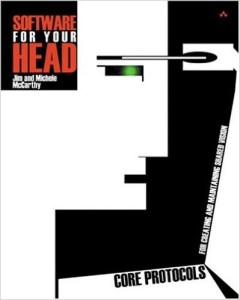
I’m GLAD to use the Core Protocols – most particularly, the Check In . I’ve had the privilege to have met Jim McCarthy – what an amazing and passionate human being. I’m honored to belong to the Booted – an online community of about 400 caring individuals, organized by Michelle and Jim McCarthy.
Jim and Michelle co-authored Software for your Head, the seminal publication investigating the dynamics of contemporary teams. It’s this book that first introduced the Core Protocols to a wide audience. Michelle and Jim were both working at Microsoft when they met and began exchanging ideas on the person-to-person relationships within teams. Soon they set out to discover a set of repeatable group behaviors that would always lead to the formation of a state of shared vision for any team. Their work led them to create the McCarthy Software Development BootCamp, out of which ultimately came the protocols and the publication. 1
Of the ten core protocols (v.3.02 is the most recent version at this writing), Check In seems to be among the most practiced. It’s used to begin a meeting or “anytime an individual or group Check In would add more value to the current team interactions.” 2 The speaker will say “I feel [one or more of GLAD, SAD, MAD, AFRAID]” followed (optionally) by a brief explanation before ending with “I’m in.” This signifies that Speaker intends to abide by the Core Commitments.
This protocol fosters a commitment to presence, which in turn begets engagement, leading to high performance of individuals and, ultimately, of the whole team. As Michelle states it:
“[The] check-in is really two things happening at the same time. One is, it’s dealing with the emotions of the people on the team. So it gives you a structured way to deal with emotions and it can be used at any time… And the other thing that’s going on when you check in is you are saying ‘I am in‘ when you’re done with your check-in. And that means I agree to the commitments that you referred to. And, so there’s kind of two things going on when you check in.” 3
– Michelle McCarthy, 12/3/12
I’m GLAD to have seen Inside Out with my wife and daughter this weekend. We love these Pixar/Disney movies, and Inside Out didn’t disappoint. My daughter is nine, so we can relate to 11-year-old Riley Anderson, the film’s protagonist, who’s actions are guided by the five emotions living in her head: Joy, Fear, Anger, Disgust and Sadness.
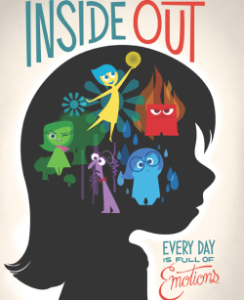 Rather than living out an advantaged “life of Riley”, the young girl soon succumbs to the stresses of moving to a new town without friends no sign of the moving van with her childhood possessions. Inside her control center, the emotions have mixed things up. Joy and Sadness have been whisked away from their posts and ended up on the outskirts of Riley’s brain. Until they find their way back with a bagful of displaced core memories, Riley will be guided only by Anger, Disgust and Fear. Not a good scenario to play out in her new surroundings.
As Riley’s real life crumbles around her, the islands of her personality (Goofball, Friendship, Hockey, etc.) similarly fall to pieces and crash into the the forgotten zone – the deep canyon where old memories and other remnants of Riley’s personality disappear forever – leaving Joy and Sadness fewer alternatives for returning to headquarters. The team’s journey is, appropriately, marked by emotions and covers a strange cognitive landscape. When they meet Bing Bong, Riley’s long-lost imaginary friend, they’re led out of Long-term Memory (an “endless warren of corridors and shelves”) and into Imagination Land (via a shortcut through Abstract Thought) to find the station – hoping to board the Train of Thought for the return trip home.
I’m GLAD and AFRAID to learn that these four emotions of the McCarthy’s Check In protocol are rooted in research by Peter Jay and other psychologists in the field of cognition. 4 These four (Glad, Sad, Mad and Afraid) map well to the emotions guiding Riley (and all of us according to Disney/Pixar). Joy, Sadness, Anger and Fear each take a role in operating the control panel in our heads. Disgust is in there, too, but the McCarthy’s feel that four are sufficient to start the self-expressions. According to Jim, additional emotions can be constructed from combinations of these four.

When talking about caring (or passion), Jim believes that it’s primarily a sublime feeling. “That’s one of the bigger feelings, you know, motivational feelings. It’s kind of a mixture of glad and scared. We CARE about something, sublime, you’re caring, you’re caring – so it’s emotional primarily.” 5
In 1980, Robert Plutchik developed a diagram (referred to as Plutchik’s 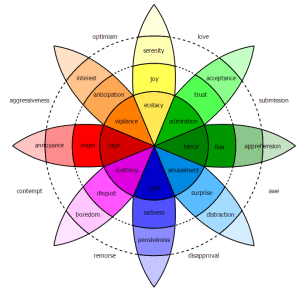 Wheel of Emotions 6) in which the X- and Y-axes describe these same four emotions. Like a color-wheel, emotions blend to create other emotions, or at least we can use their proximity to infer relationships. For instance, in Plutchik’s wheel, the area between Anger and Sadness is occupied by Disgust, another of Plutchik’s eight basic emotions. Similarly:
- between Joy and Anger is Anticipation, Interest & Vigilance
- between Joy and Fear is Admiration, Trust & Acceptance
- between Fear and Sadness is Amazement, Surprise & Distraction
The blending of Plutchik’s eight basic emotions yields eight derivative emotions. When Checking In, we can use these blends or proximities to more accurately state how we’re feeling.
I’m SAD and AFRAID that this movie so well encapsulates the power of empathy. One of the primary lessons of the film is the fundamental importance of Emotional Intelligence. Also refereed to as EQ, emotional intelligence is the ability to understand our own emotions and the emotions of others in order to guide our thinking and behavior and help support others when they need comfort. “Communicating our needs, empathizing with others, and solving problems effectively all require emotional intelligence.” 7
Inside Out drives home the necessity and power of empathy with a very moving scene. 8
While looking for the train station in Imagination Land, the team discovers that workers (Memory Erasers) are knocking down buildings. Rubble is being moved by big machines. Bing Bong sees his wagon in the mess.
“My Rocket!”
The Memory Erasers use a bulldozer to dump Bing Bong’s wagon deep into the forgotten zone. It is gone.
“Riley can’t be done with me,” utters Bing Bong, devastated.
Joy, focused on getting back to headquarters with the core memories, bounces up to a sullen Bing Bong. “Hey! It’s gonna be okay. We can fix this. We just need to get back to headquarters. Which way to the train station?”
Oblivious to Joy, Bing Bong laments “I’ve had a whole trip planned for us (he & Riley).”
Joy continues her attempt to force happiness. “Hey, who’s ticklish? Huh? Here comes the Tickle Monster.” No reaction from Bing Bong.
“Hey, Bing Bong, look at this.” Joy makes funny face – still no reaction.
“Oh, here’s a fun game. You point to the train station and we all go there. Won’t that be fun?! C’mon. Let’s go!”
Sadness sides up to Bing Bong. “I’m sorry they took your rocket. They took something that you loved. It’s gone, forever.”
“Sadness!” Joy admonishes. “Don’t make him feel worse.”
“Sorry.”
“It’s all I had left of Riley,” admits the imaginary friend.
“I bet you and Riley had great adventures.”
“Oh, they were wonderful. Once we flew back in time. We had breakfast twice that day.”
“Sadness!” implores Joy.
“That sounds amazing,” continues Sadness. “I bet Riley liked it.”
“Oh she did. We were best friends.” Bing Bong starts to cry.
Sadness stretches her arm around the friend. “Yeah. That’s sad.”
Bing Bong is sobbing candy tears.
“Ughh…” sighs an impatient Joy.
Bing Bong’s tears slow, then stop. He regains composure. “I’m okay now. C’mon. The train station is this way.”
Bewildered, Joy asks Sadness “How’d you do that?”
“I don’t really know. He was sad so I listened to what…”
“Hey! There’s the train!” [triumphant music swells up]
I’m SAD and MAD that one of my strengths is so often glossed over in hiring decisions. As managers, coaches and scrum masters, we’ve often been told that this “soft skill” is useful, but it doesn’t get nearly the attention of certifications and the many other bullet points on our resumes.
Without the practice of empathy, team members are stuck without emotional understanding, unable to “find the train station”. Our jobs as caretakers and team mates is to give account to these feelings, but tread lightly. Checking In is a powerful enabler of engagement, but no one is coerced to check in. And if someone checks in, passes (checks in without assigning emotions), or checks out, there need not be reasons attached. Further, others may not judge, shame, hassle, interrogate or punish anyone who passes or checks out. The reason is that we all have freedom, and our team relationships are built on the trust that these freedoms exist equally for all members at all times.
So when a team member expresses any emotion that does not resemble joy, it’s okay to let them be. Ask if they’d like to check in, but do not force them to. Certainly we must refrain from coercing them to be glad. When they want to talk, just being present – fully present – can be the most effective action to take.
I’m IN!
endnotes:
1 – from the back cover of Software for Your Head – see description at: www.amazon.com/Software-Your-Head-Protocols-Maintaining
2 – version 3.02 of Core Protocols – www.mccarthyshow.com/online/
3 – The Core Protocols – Interview with Jim and Michele McCarthy by Dan Mezick on Dec 03, 2012 – www.infoq.com/interviews/mccarthy-core-protocols
4 – ibid
5 – ibid
6 – Robert Plutchik’s wheel of emotions – Wikipedia – www.wikipedia.org/wiki/Contrasting_and_categorization_of_emotions#Plutchik.27s_wheel_of_emotions
7 – The Psychology of Inside Out: A Beautiful Lesson in Emotional Intelligence, Dr. Andrea Letamendi – www.underthemaskonline.com/the-psychology-of-inside-out-a-beautiful-lesson-in-emotional-intelligence/
8 – Pixar Animation Studios and Disney present Inside Out (2015) – Story by Pete Docter and Ronnie del Carmen. Screenplay by Meg LeFauv, Josh Cooley and Pete Docter. – www.imdb.com/title/tt2096673/fullcredits

 On July 25th, another successful 5Saturdays program wrapped up at Estancia HS in Costa Mesa, CA, and twelve students shared their takeaways with me on the podcast. These high-school-aged participants talked about the lessons learned over their five weekend sessions, focusing on job readiness and effective communications.