Victor is joined by Dale Ellis (@theDigitalDale), Jason Kerney (@JasonKerney), Zach Bonaker (@ZachBonaker) and Garrett Borunda (LinkedIn) at the Cape Rey in Carlsbad for a lively morning of Agile and Coffee.
To share an abundance of topics, Victor is joined by Dale Ellis (@theDigitalDale), Larry Lawhead (@LarryLawhead), Jon Jorgensen (@waterScrumBan) and Dr. Dave Cornelius (@DrCorneliusInfo) in the Irvine studio for a lively morning of Agile and Coffee.
We’re at a crossroads, and you can help! Is this format working for you? How can we improve upon it? AND – what ideas do you have for recording the sessions over the interwebs? Would you like to join one? Let Vic know by twitter or email.
Mark your calendars for Dr. Dave’s 5 Saturdays program’s Train the Facilitators workshops: May 30th and June 6th. More info at 5Saturdays.org
Reach out to Vic (@AgileCoffee) on Twitter and use the hashtag #tellAgileCoffee to interact with us on an upcoming episode.
This episode is composed of two separate sessions. The first part was recorded on location at the 9th Annual Agile Open Northwest (Portland, OR) with Ben Sherwood, Michael Wolf, Alicia Lanier and Ian Savage. For the second part, I returned to the home studio and was joined by Dale Ellis, Jon Jorgensen, Brett Palmer and Larry Lawhead.
Between the two sessions, we dove deep into the following topics:
Facilitation Tools – Groupwork cards
Adaptive Action and Agile – aka What? So what? Now what?
One more huge shout of gratitude to Ian, Alicia, Michael and Ben, to Diana, Tündér, Ainsley and all participants and volunteers at #AONW.
For this episode, Vic is joined by Larry Lawhead (@LarryLawhead), Dale Ellis (@thedigitaldale) and Dr. Dave Cornelius (@DrCorneliusInfo) for quick and efficient morning of Agile and coffee.
Agile coaching demands many skills of the practitioner. In addition to being conversant in common agile processes, we are also called to serve as teacher, facilitator, mentor, counselor, negotiator, and leader. Of course, this is a partial list; there may be no limit to the skills identified as valuable to our coaching profession.
Where did you learn these skills? If you weren’t born with these skills or have them injected into your being, how did you acquire them? Books, videos and training courses can help, but on the job is perhaps the quickest and most lasting method. Did you have someone training you how to train? How to facilitate or lead your first team? Chances are that you were thrown into the fire like most of us.
Now imagine that you did have a mentor to guide you along your path, someone to show you how to lead a retrospective and offer advice when your team just stared at you dumbly. I’m not talking about your CSM instructor or your boss who gives you encouragement once a week, but an honest-to-goodness partner with you on the job.
That is one pattern of pair-coaching.
Here is another example. Let’s suppose that you’re involved in a transformation effort. You and a colleague want to introduce agile methods and scrum practices that will represent a different way of working, but some team members want nothing to do with this – for them the medicine is hard to swallow.
This is a case where your partner might play a more “prescriptive” role, clarifying the need and structural changes with little emotion invested in her delivery. Your role as the counterpart would be to offer deep empathy – providing an open ear or a shoulder to cry on – while also offering a softer interpretation of why the organization is trying this change. You, the “progressive”, help the transition to this different mindset.
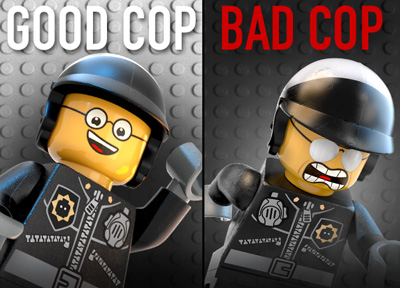
More than a “good cop / bad cop” relationship, the Contrarian pattern allows for divergent viewpoints to both be expressed equally.
Pair-coaching is not anything new in the workplace. You may be practicing one or more patterns without being aware of it. Once made visible, the value of coaching in pairs should become apparent.
There are many patterns that pair-coaches can fill. A few that we will examine include:
Trainer / Observer
Driver / Navigator
Contrarian (Progressive / Prescriptive)
Senpai / Kohai (mentor / protege)
Co-learners
Trainer / Observer
With new teams adopting agile practices, it’s almost certain that training will be necessary. Often a trainer works alone; showing up to set up the room, greet arriving participants, communicate & demonstrate the concepts, take questions and mind the agenda (including breaks, meals and other time-boxed events). That could be quite a lot to handle, especially if the audience is large or varied in their prior experience with (and reception of) the topics.
With a partner, much of the burden is eliminated from the primary trainer’s responsibility. (For non-training events, a co-facilitator becomes useful for the same reasons.)
In this pair-coaching scenario, one coach may lead the training while the second may:
observe to offer feedback later
tag-in and lead other slides of same training
be called upon as an expert (SME) or for her experience/validation
scan the audience for outliers / those needing attention
Driver / Navigator
Han had Chewie. Michael Knight had KITT.
This pairing closely resembles the Trainer/Observer, but it can happen outside of the full team environment. In other words, an activity with only the coaches participating (e.g. drafting a retrospective agenda) can benefit from a second pair of eyes. Similar to how developers may engage in pair-programming, two (or more) coaches can make light work of otherwise daunting tasks, saving time, catching errors and preventing rework. A Product Owner / ScrumMaster relationship may make use of this dynamic during (for instance) a story writing exercise or preparing for a complex backlog grooming session.
To extend the navigator role a bit, an internal coach may pair with an external coach to provide a much needed map of the terrain. When outsiders come to an engagement, the organization may be charged with mistrust and fear (why else would the outsider have been brought in?). Having a “man on the inside” helps to get the “lay of the land” with regards to the organization’s culture and politics, potentially helping to avoid the minefield altogether.
The Contrarian
The earlier example showed one instance of this common usage. As a coach, you may find there are times when the team (or one member) resists what is being suggested, even being demanded. In these cases, try having one partner offer a prescriptive approach, while the other provides counterpoint. If there’s a bitter pill, there should be empathy.
Additionally, when constructive conflict is habitually missing from team discussions, introducing an alternate viewpoint may encourage necessary debate. Two partners can take opposing views in the effort to model a constructive dialogue.
Senpai / Kohai
The Japanese culture is rich in traditions of well-defined social behaviors, and the senpai/kohai relationship is one of the most popular. Similar to a mentor / protege (or a senior / junior) pairing, this role can be thought of as a more formalized “buddy system” to be used when newer members join an organization (eg. company, school, sports club). The senpai serves as a mentor of sorts, showing his charge the ropes – guiding, protecting and teaching. The kohai offers his full attention and respect to the senior, even though the two may be very close in age and status.
This can be a very beneficial role to play as an agile coach, whether you are the mentor of the mentee. Thinking back to your first days on the job, did someone help you with onboarding, telling you how to navigate the HR paperwork, where to submit the expense reports and what time is best for booking the meeting rooms? In Japan, the two may bond over dinners or drinks engaged in casual conversations, and the senpai/kohai relationship often lasts many years or decades, usually well past the individuals’ tenures at the organization.
Co-learners
When the subject matter is new to both participants, or the terrain is dangerous, each coach helps the other understand in very short feedback loops. Much like infantry soldiers on a dangerous battlefield, high-performing teams offer encouragement to each other as they make their way through uncharted and challenging territory.
The experience levels of both participants are often close in this role, neither being expert in the new subject or working environment. This type of dynamic may happen when we pair up to do exercises at a conference or other training session. If you’ve ever joined a coaching circle, your assignment could call for you to relate your experiences to a partner who’s job might be to actively listen and understand before swapping roles.
Much in the same vein as saying “two heads are better than one”, I think of the parable of the blind men describing the elephant. Each of us has our own perspective on things, but by listening to and learning from each other, we help increase our own knowledge bit by bit.
What’s Next?
Those are five of the roles that can be played by coaches who work in pairs. It’s likely that there are more, whether obvious or not. The goal of this post was to define these roles so that we can have a common set of terms to use when discussing how to become better coaches by working in pairs. Although I believe that there is very large value to be discovered by pair-coaching, I am not calling for every coach to work with a partner on all projects at all times.
Over the next several months I will be attending Agile Opens (#AONW begins this week), Coach Camps (I will host ACCUS in Irvine) and a Coaching Retreat, and at each event I will do my best to engage others in this dialogue. It’s my hope to use the matrix below to see where we feel each role fits best given the situations I just described. If you see me there, feel free to pair up with me!
At the latest lean coffee, we had two cards with a similar question: how do you neutralize the bad apples / stop the eye-rolling? Later that night I remembered something I thought might apply, so below I try to craft it into a parable.
(This post offers a huge tip of the hat to Robert Anton Wilson whose first chapter of “Quantum Psychology” describes a similar “parable about [this] parable”. Chapter nine of “The Trial” by Franz Kafka includes this central tale which Wilson treats as zen koan.)
There was once a young scrummaster who had achieved some early success. His new team, however, offered only resistance to his words. Throughout his first two sprints he employed many methods to convince or cajole the team to change their perspective and accept agile / scrum. He offered empathy, used silence and questioning, provided studies and “facts” to support his claims. The scrummaster grew impatient and threatened the team, but they simply laughed him off.
Finally he swallowed his pride and approached the agile coach. She offered the scrummaster a cup of tea.
“This team is impossible!” the scrummaster exclaimed. “Why won’t they buy-in?”
“Let me tell you a story,” the coach offered. After sipping her tea, she began:
A man from the countryside comes up to the door of the Law, guarded by a doorkeeper, and asks for entry. The doorkeeper says he can’t let him in to the law right now. The man thinks about this, and then he asks if he’ll be able to go in later on.
‘That’s possible,’ says the doorkeeper, ‘but not now’.
The man waits and grows older. Any time he asks, the doorkeeper rebukes him. The man offers bribes to this doorkeeper, and the guard accepts each offer saying as he pockets the money ‘I’ll only accept this so that you don’t think there’s anything you’ve failed to do’. Still, the man is not allowed entry.
Over many years, the man tries time and again to get inside. In the first few years he curses his unhappy condition out loud, but later, as he becomes old, he just grumbles to himself. He becomes senile…
Finally his eyes grow dim, and he knows doesn’t have much longer to live. In the moment before he dies, he brings together all his experience from all this time into one question which he has still never put to the doorkeeper…
‘Everyone wants access to the law,’ says the man, ‘how come, over all these years, no-one but me has asked to be let in?’
The doorkeeper can see the man is near death. ‘Nobody else could have got in this way, as this entrance was meant only for you. Now I’ll close it forever’. As the door is slammed shut, the man expires.
The scrummaster all but spits out his tea. “He died?” “Indeed,” the coach assured.
Another sprint passes, and the scrummaster returns to the agile coach, finding her in the lounge outside her office.
“I’ve considered this story from many angles, and I have questions. If the door existed only for this man, why was he not allowed to enter? Why was the door left tantalizingly open? Why did the guard close the door only when the man was too old and weak to enter?”
As the coach poured two cups of tea, the scrummaster continued. “Am I the man in this parable? Is my team the majesty beyond the door? Who is the doorkeeper?” Ignoring his tea, the scrummaster implored “Please. Explain to me the lesson of this dark parable.”
“I will explain it to you,” the coach promised, “if you follow me into my office.”
The coach stepped into the room, quickly turned, and slammed the door in the scrummaster’s face.
At that moment, the scrummaster experienced enlightenment.