team dynamics

  • 45. Lean Coffee on a company visit to EMC

    It’s an onsite company visit! Vic sits down with four employees representing Dev, QA & PMO at the Data Protection Unit of EMC Corp in Irvine, CA, to discuss how the transformation to Agile has changed things up. Also on hand is Scott Dunn (@sdunnRocket9), facilitating the transformation activities and coaching at many levels within the business unit.

    Scott mentioned the Certified LeSS Practitioner: Principles to Practices class led by Craig Larman – May 9 in Tustin, CA

  • 43. Scrum Coaching Retreat in San Diego, pt.1

    Vic with Bernie Maloney and Kim Brainard
    Vic with Bernie Maloney and Kim Brainard

    Recorded at the Scrum Coaching Retreat in San Diego with Vic (@AgileCoffee) and guests Bernie Maloney (@berniemaloney) and Kim Brainard (@agilebrain1). Dr.Dave joins near the end.

    Bernie and Kim talk about their experiences with their team (Transformers!). For two+ days at the retreat, Bernie acted as the team’s Product Owner, while Kim served as Scrum Master. They share their perspective on how their topic evolved and how the team formed, stormed, normed and ultimately performed.


    Have you been to a Coaching Retreat? Let us know on Twitter by using the hashtag #TellAgileCoffee

    btw – Bernie broadcasted/recorded the interview on Periscope. It’s archived on katch.

  • 42. Deep Thought Gives an Answer to Everything

    Vic (@AgileCoffee) is joined by Colleen Kirtland (@CSKirtland), Brett Palmer (@Brett_Palmer) and Larry Lawhead (@LarryLawhead) outside a Coffee Bean and Tea Leaf in Irvine.

    In this episode, our Agile heroes discuss:

    • What is the Meaning of Life?
    • Agile Community
    • Yoga & Leadership
      • Sensitivity is not weakness or vulnerability. It is clarity of perception and allows judicious, precise action.” – B. K. S. Iyengar
      • Colleen’s posts on LinkedIn
    • Funding Agile Teams
      • we talked about the Slow Money movement
    • Discovering the Pace of Change

    The introduction of episode 42 contained a clip from episode 4 of “The Hitchhiker’s Guide to the Galaxy” 1979 BBC radio series, written by Douglas Adams.

  • 41. The One Where We Win an Oscar

    “… and the Oscar for best podcast goes to…”

    Vic is joined by Zach Bonaker (@ZachBonaker) and Larry Lawhead (@LarryLawhead) at the Cape Rey in Carlsbad for a lively morning of Agile and Coffee.

    In this episode, our Agile heroes discuss:

    • Fallacy of Training
    • Shortcuts: no shu-ha-ri
    • Irony of Agile and Technology
    • Why Scrum?
  • 39. An Ecstatic Start to the New Year

    Hi, Hello and Happy 2016!

    Back from our hiatus, Vic is once again joined by Jon Jorgensen (@WaterScrumBan), Zach Bonaker (@ZachBonaker) and Garrett Borunda (LinkedIn) at the Cape Rey in Carlsbad for a lively morning of Agile and Coffee.

    In this episode, our Agile heroes discuss:

    • What to do at the first bump in the road
    • Which practices would you eliminate?
    • Thinking big and small

    Reach out to Vic (@AgileCoffee) and use the hashtag #tellAgileCoffee to interact with us on an upcoming episode.

    announcements:

  • Inside Out and the Check In core protocol

    I’m checking in, Inside Out style: a bit more detailed than a standard protocol check in, but shorter than the movie.

    SW-for-your-head

    I’m GLAD to use the Core Protocols – most particularly, the Check In . I’ve had the privilege to have met Jim McCarthy – what an amazing and passionate human being.  I’m honored to belong to the Booted – an online community of about 400 caring individuals, organized by Michelle and Jim McCarthy.

    Jim and Michelle co-authored Software for your Head, the seminal publication investigating the dynamics of contemporary teams. It’s this book that first introduced the Core Protocols to a wide audience. Michelle and Jim were both working at Microsoft when they met and began exchanging ideas on the person-to-person relationships within teams.  Soon they set out to discover a set of repeatable group behaviors that would always lead to the formation of a state of shared vision for any team. Their work led them to create the McCarthy Software Development BootCamp, out of which ultimately came the protocols and the publication. 1

    Of the ten core protocols (v.3.02 is the most recent version at this writing), Check In seems to be among the most practiced. It’s used to begin a meeting or “anytime an individual or group Check In would add more value to the current team interactions.” 2  The speaker will say “I feel [one or more of GLAD, SAD, MAD, AFRAID]” followed (optionally) by a brief explanation before ending with “I’m in.” This signifies that Speaker intends to abide by the Core Commitments.

    This protocol fosters a commitment to presence, which in turn begets engagement, leading to high performance of individuals and, ultimately, of the whole team. As Michelle states it:

    “[The] check-in is really two things happening at the same time. One is, it’s dealing with the emotions of the people on the team. So it gives you a structured way to deal with emotions and it can be used at any time… And the other thing that’s going on when you check in is you are saying ‘I am in‘ when you’re done with your check-in. And that means I agree to the commitments that you referred to. And, so there’s kind of two things going on when you check in.” 3

    – Michelle McCarthy, 12/3/12


    I’m GLAD to have seen Inside Out with my wife and daughter this weekend. We love these Pixar/Disney movies, and Inside Out didn’t disappoint. My daughter is nine, so we can relate to 11-year-old Riley Anderson, the film’s protagonist, who’s actions are guided by the five emotions living in her head: Joy, Fear, Anger, Disgust and Sadness.

    insideout_headRather than living out an advantaged “life of Riley”, the young girl soon succumbs to the stresses of moving to a new town without friends no sign of the moving van with her childhood possessions. Inside her control center, the emotions have mixed things up. Joy and Sadness have been whisked away from their posts and ended up on the outskirts of Riley’s brain. Until they find their way back with a bagful of displaced core memories, Riley will be guided only by Anger, Disgust and Fear. Not a good scenario to play out in her new surroundings.

    As Riley’s real life crumbles around her, the islands of her personality (Goofball, Friendship, Hockey, etc.) similarly fall to pieces and crash into the the forgotten zone – the deep canyon where old memories and other remnants of Riley’s personality disappear forever – leaving Joy and Sadness fewer alternatives for returning to headquarters. The team’s journey is, appropriately, marked by emotions and covers a strange cognitive landscape. When they meet Bing Bong, Riley’s long-lost imaginary friend, they’re led out of Long-term Memory (an “endless warren of corridors and shelves”) and into Imagination Land (via a shortcut through Abstract Thought) to find the station – hoping to board the Train of Thought for the return trip home.


    I’m GLAD and AFRAID to learn that these four emotions of the McCarthy’s Check In protocol are rooted in research by Peter Jay and other psychologists in the field of cognition. 4 These four (Glad, Sad, Mad and Afraid) map well to the emotions guiding Riley (and all of us according to Disney/Pixar). Joy, Sadness, Anger and Fear each take a role in operating the control panel in our heads. Disgust is in there, too, but the McCarthy’s feel that four are sufficient to start the self-expressions.  According to Jim, additional emotions can be constructed from combinations of these four.

    5emotions-of-insideout

    When talking about caring (or passion), Jim believes that it’s primarily a sublime feeling. “That’s one of the bigger feelings, you know, motivational feelings. It’s kind of a mixture of glad and scared. We CARE about something, sublime, you’re caring, you’re caring – so it’s emotional primarily.” 5

    In 1980, Robert Plutchik developed a diagram (referred to as Plutchik’s Plutchik's wheel of emotionsWheel of Emotions  6) in which the X- and Y-axes describe these same four emotions. Like a color-wheel, emotions blend to create other emotions, or at least we can use their proximity to infer relationships. For instance, in Plutchik’s wheel, the area between Anger and Sadness is occupied by Disgust, another of Plutchik’s eight basic emotions. Similarly:
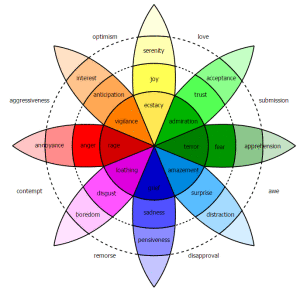
    • between Joy and Anger is Anticipation, Interest & Vigilance
    • between Joy and Fear is Admiration, Trust & Acceptance
    • between Fear and Sadness is Amazement, Surprise & Distraction

    The blending of Plutchik’s eight basic emotions yields eight derivative emotions. When Checking In, we can use these blends or proximities to more accurately state how we’re feeling.


    I’m SAD and AFRAID that this movie so well encapsulates the power of empathy. One of the primary lessons of the film is the fundamental importance of Emotional Intelligence. Also refereed to as EQ, emotional intelligence is the ability to understand our own emotions and the emotions of others in order to guide our thinking and behavior and help support others when they need comfort. “Communicating our needs, empathizing with others, and solving problems effectively all require emotional intelligence.” 7

    Inside Out drives home the necessity and power of empathy with a very moving scene. 8

    While looking for the train station in Imagination Land, the team discovers that workers (Memory Erasers) are knocking down buildings. Rubble is being moved by big machines. Bing Bong sees his wagon in the mess.

    “My Rocket!”

    The Memory Erasers use a bulldozer to dump Bing Bong’s wagon deep into the forgotten zone. It is gone.

    “Riley can’t be done with me,” utters Bing Bong, devastated.

    Joy, focused on getting back to headquarters with the core memories, bounces up to a sullen Bing Bong. “Hey! It’s gonna be okay. We can fix this. We just need to get back to headquarters. Which way to the train station?”

    Oblivious to Joy, Bing Bong laments “I’ve had a whole trip planned for us (he & Riley).”

    Joy continues her attempt to force happiness. “Hey, who’s ticklish? Huh? Here comes the Tickle Monster.” No reaction from Bing Bong.

    “Hey, Bing Bong, look at this.” Joy makes funny face – still no reaction.

    “Oh, here’s a fun game. You point to the train station and we all go there. Won’t that be fun?! C’mon. Let’s go!”

    Sadness sides up to Bing Bong. “I’m sorry they took your rocket. They took something that you loved. It’s gone, forever.”

    “Sadness!” Joy admonishes. “Don’t make him feel worse.”

    “Sorry.”Sadness comforts Bing Bong

    “It’s all I had left of Riley,” admits the imaginary friend.

    “I bet you and Riley had great adventures.”

    “Oh, they were wonderful. Once we flew back in time. We had breakfast twice that day.”

    “Sadness!” implores Joy.

    “That sounds amazing,” continues Sadness. “I bet Riley liked it.”

    “Oh she did. We were best friends.” Bing Bong starts to cry.

    Sadness stretches her arm around the friend. “Yeah. That’s sad.”

    Bing Bong is sobbing candy tears.

    “Ughh…” sighs an impatient Joy.

    Bing Bong’s tears slow, then stop. He regains composure. “I’m okay now. C’mon. The train station is this way.”

    Bewildered, Joy asks Sadness “How’d you do that?”

    “I don’t really know. He was sad so I listened to what…”

    “Hey! There’s the train!” [triumphant music swells up]


    I’m SAD and MAD that one of my strengths is so often glossed over in hiring decisions. As managers, coaches and scrum masters, we’ve often been told that this “soft skill” is useful, but it doesn’t get nearly the attention of certifications and the many other bullet points on our resumes.

    Without the practice of empathy, team members are stuck without emotional understanding, unable to “find the train station”. Our jobs as caretakers and team mates is to give account to these feelings, but tread lightly. Checking In is a powerful enabler of engagement, but no one is coerced to check in. And if someone checks in, passes (checks in without assigning emotions), or checks out, there need not be reasons attached. Further, others may not judge, shame, hassle, interrogate or punish anyone who passes or checks out. The reason is that we all have freedom, and our team relationships are built on the trust that these freedoms exist equally for all members at all times.

    So when a team member expresses any emotion that does not resemble joy, it’s okay to let them be. Ask if they’d like to check in, but do not force them to. Certainly we must refrain from coercing them to be glad. When they want to talk, just being present – fully present – can be the most effective action to take.

    I’m IN!


    endnotes:

    1 – from the back cover of Software for Your Head – see description at: www.amazon.com/Software-Your-Head-Protocols-Maintaining

    2 – version 3.02 of Core Protocols – www.mccarthyshow.com/online/

    3 – The Core Protocols – Interview with Jim and Michele McCarthy by Dan Mezick on Dec 03, 2012 – www.infoq.com/interviews/mccarthy-core-protocols

    4 – ibid

    5 – ibid

    6 – Robert Plutchik’s wheel of emotions – Wikipedia – www.wikipedia.org/wiki/Contrasting_and_categorization_of_emotions#Plutchik.27s_wheel_of_emotions

    7 – The Psychology of Inside Out: A Beautiful Lesson in Emotional Intelligence, Dr. Andrea Letamendi – www.underthemaskonline.com/the-psychology-of-inside-out-a-beautiful-lesson-in-emotional-intelligence/

    8 – Pixar Animation Studios and Disney present Inside Out (2015) – Story by Pete Docter and Ronnie del Carmen. Screenplay by Meg LeFauv, Josh Cooley and Pete Docter. – www.imdb.com/title/tt2096673/fullcredits
  • 35. It’s a CROSSOVER! Agile Coffee for Humans

    Victor is joined by Jon Jorgensen (@waterScrumBan) and Ryan Ripley (@RyanRipley) of the excellent Agile for Humans podcast for a double-sized, ultra packed episode of Agile Coffee for Humans.

    In this episode, our Agile heroes discuss:

    • The HR Side of Agile – Performance Reviews, Raises, & Transparency
    • The Business of Agile – How we justify the investment in agility
    • Ken’s Complaint -Trademarking Scrum Group
    • Crossing the line – push and pulling hair
    • Organisational Psychotherapist, the new coach – a reflection on Bob Marshall’s Why Me?
    • Agile Transformation – The REST of the story (like Paul Harvey)
    • Agile games, simulations and learning activities – see my post on games

    Holding Space article by Heather Plett

    book: Crucial Conversations by Patterson, et al

    Reach out to Vic (@AgileCoffee) on Twitter and use the hashtag #tellAgileCoffee to interact with us on an upcoming episode.

  • 34. Transparency as a Tool to Build Trust

    Victor is joined by Dale Ellis (@theDigitalDale) and Larry Lawhead (@LarryLawhead) on a beautiful SoCal morning for Agile and Coffee.

    In this episode, our Agile heroes discuss:

    • Limits to transperency
    • Project reporting (is the Burndown enough?)
    • Mandated documentation in Agile
    • Project definition phase
    • Getting teams to behave like teams
    • Engaging the non-participative team member

    Reach out to Vic (@AgileCoffee) on Twitter and use the hashtag #tellAgileCoffee to interact with us on an upcoming episode.

  • 33. Scrum Coaching Retreat Seattle

    Lean Coffee recorded in Seattle, June 24, 2015

    Vic (@AgileCoffee) attended the Scrum Alliance’s fourth Scrum Coaching Retreat in the USA. It was three days of examination of what it means to be a coach in a scrum environment and how we can improve our coaching methods worldwide.

    In the first two days, participants had the opportunity to pitch a project they wished to focus on. Everyone then joined a project team and organized using scrum processes and roles. We had three sprints (spanning the two days) in which to iterate and increment on a delivery of our final products. The final day was devoted to an Open Space event and a closing retrospective.

    One of the projects created can be found at AgileLeadershipToolkit.com. I’ll make others available once I receive explicit permission and links from their creators.

    Special kudos go out to Stewart Young (@Stuartliveart) of illustrationstation.co.uk for completing some amazing artwork throughout the three days.

    Vic hosted a lean coffee during Open space on the third day, and he was joined by:

    Topics included:

    • Overcoming team dysfunctions at the Scrum Coaching Retreat
    • Alternative formats for a three-day retreat
    • How to do podcasts (see below)
    • PO coaching beyond the basics
    • Impact Mapping
    • Value proposition for coaching vs just training

    For more information on retreats

    Links to previous (and upcoming) Coaching Retreats in the USA:

    1. Boulder, CO – Dec 7-9, 2011
    2. Chandler, AZ – Dec 4-6, 2013archive of projects
    3. Raleigh (Chapel Hill), NC – Oct 28-30, 2014
    4. Seattle, WA – June 22-24, 2015
    5. Irvine, CA – Spring 2016

    Podcasting Tools and Techniques

    I produce my shows old school – by gathering participants in a room and recording with a bunch of mics. (I have a degree in audio engineering, so I’m a bit of an audiophile.) It’s fun, and nothing beats the face-to-face communication with all its nuances and clarity. We meet about twice a month in a mostly quiet space, and it takes my about 10-15 minutes to set up the equipment and do a quick check of levels.

    For these bigger on location recording (from 4 to 6 attendees), I use a Behringer X1222 mixing board and Audio Technica ATR2100 or similar mics, plug it into my laptop and be good. [None of these links are affiliate links – just plain links to Amazon.] When it’s only a few of us, I’ll just bring my Zoom H5 handy recorder to blug mics in to – no need to lug my laptop around. In my home studio where it’s only me, I either plug my mic into the laptop or go through a smaller Behringer Xenyx mixer.

    For post-production I use the free software Audacity (for PC). It does everything I need; I only do a minor amount of editing, and I like to tweak the levels somewhat. I export the file as MPEG Layer 3 (.mp3) format and load it into my local iTunes to enter the metadata (pretty much just cut-and-paste from a template). Then it’s time to upload to my audio host. Libsyn costs about $12 / month, but you can get a cheaper plan with them (or free elsewhere) if you podcast less frequently (I post at least two Agile Coffee podcasts a month and sometimes other projects as well). Libsyn also provides download stats. When it’s time to announce the new episode, the Blubrry PowerPress plugin (free) to my WordPress site does the heavy lifting by submitting the feed to iTunes & Stitcher as well as embedding an audio player on the post’s page.

    Here are some of the Agile-themed podcasts I consume:

    That’s it. Hit me up with questions at @AgileCoffee.

  • Agile games, simulations and learning activities

    A colleague approached me recently with a request. He was about to meet with a new division of his company and lead transformation activities at the team level, so he wanted advice on the best agile games to include. As usual, I turned my advice into a blog post so that (hopefully) others can benefit from my experiences.

    We all know that games are fun and that humans are hard-wired to play. Like most coaches, I use games, simulations and other learning activities fairly liberally in my engagements, but I want to be clear: I never play games just to play games. There has to be a need for taking an activity out of my toolbox and introducing it to the team.

    Activities that get us out of our chairs are generally good. The body moves around and gets blood up to our brains. It gives us a chance to get away from the book-fed material and internalize the lessons. All good points, but still we often sell the benefit of game-play short to say something like “this section of the training material is dry, so let’s put a game here”.

    Including a game or simulation should be thought of as a “teeing up” of the learning objective. Another way to say it: the game creates an effective canvas for painting the picture. It prepares the learners to “get” the message. Just as I wouldn’t force a game into my curriculum for the sake of having a game, I also wouldn’t ignore the opportunity to reinforce the training objective with a valid learning activity.

    My favorite games for teaching lean and agile concepts

    Before I share my list, a quick word on terms. (Credit goes to Derek Wade @derekwwade for this description in the Google group: Agile Games)

    • Learning Activity – Exercises that engage people, helping them reach a conclusions and assist in learning (thereby increasing performance).
    • Problem-Based Learning – Learning activities which require participants to solve problem relating to a specific subject.
    • Simulation – A problem-based learning activity that has components which cognitively mirrors the environment, methods, problems and practices of the learning domain.
    • Game – A simulation which has rules of play to either win/lose (finite game) or to keep the game in play (infinite game).

    Jargon aside, here’s a list of games:

    • Buy a Feature – Teaches feature prioritization
      • Best played in groups of 3-8. Takes 10-15 minutes.
      • Each player receives two items: (1) a handout with a menu of features and their prices (2) a sum of play money. (Features can be anything: items to have on a vacation, goals of a two-day training, benefits of a high-functioning team, etc.) The play money should contain a variety of denominations. The sum total of all players’ money should be less than the total of all feature prices – this introduces scarcity and forces the team to make trade-offs because it’s not possible to purchase all items on the list.
      • Players take turns using their individual sums of money to but the features they deem most valuable. Once players have spent most of their funds (either they don’t have enough individually to make another purchase or they don’t value what’s left on the menu to buy anything else), the group will pool the remaining funds and discuss what to buy from the remaining items.


    • Human Knot [ link to example video ]- Teaches self-organization
      • Best played in groups of 6-20. Takes about 2-3 minutes per round, including instructions.
      • Start with all players standing to form a large circle, facing inside the circle. Everyone moves in close (shoulder-to-shoulder) and reaches their left hand into the mix, grabbing the left hand of another player (not their immediate neighbor). Next, reach in the right hands and grab a new person’s right hand (again, not the neighbor next to you).
      • While keeping all hands connected, the group then proceeds to twist and turn out of the scrambled knot they’ve formed. After a minute or more, the group should once again return to a large circle of people clasping hands.
      • Remember: Safety first. If someone is getting squeezed or about to trip, it’s better to release a hand or two tham to end up with broken bones or sprained thingies.
      • It’s fun if two or more groups of equal number compete to see who can “untie” themselves first.


    • Multitasking [ link ] – Shows how multi-tasking reduces effectiveness.
      • Played individually at a table or whiteboard. Playing two rounds takes less than 5 minutes.
      • Each player needs one sheet of paper (or on a whiteboard) and something to write with. It’s best if they each have their own stopwatch (phone, duh), but the facilitator can monitor time for the group if necessary.
      • The paper will have three blank columns to be filled in, and the task is the same for each of two rounds. Column one will contain the letters A thru J; column two lists the digits 1 thru 10; column three will have roman numerals I thru X. All finished columns should contain their ten elements in their proper order.
      • The difference between the two rounds comes in how the columns get filled out. in round one, players must write one letter, followed by one digit, followed by one roman numeral, then repeat. In round two, players should write all letters first, before moving on to the digits, and filling in the roman numerals last.
      • Each of the two rounds is timed, and we see that the multitasking of round one consumes a greater time than the focused task completion of round two.


    • Pair-Origami (link) – Illustrates the importance of face-to-face (vs. distributed) communication.
      • Need total of six or more players. Takes about 10-15 minutes.
      • Divide the players into three groups (A, B & C). Players for pairs in each group. Each pair consists of a folder and a PO (product owner) or manager. All folders get a single sheet of 8.5×11 paper, and each PO/manager receives an instruction page (download link).
        • Players in group A sit side-by-side. Only the folder player may fold the origami, but both partners may see the instruction sheet.
        • Players in group B sit face-to-face. Only the folder player may fold the origami. The PO/manager may give feedback but may not show the instructions to the folder.
        • Players in group C sit back-to-back. Only the folder player may fold the origami. The PO/manager may read/explain the instructions to the folder but may not see the origami as it’s being folded.
      • When the timer starts, all pairs get to work. When a pair completes their origami, their time gets recorded. The facilitator may (mercifully) call time when it’s apparent that pairs in group C are about to explode.


    • Penny Flip game (link) – Emphasizes value of small batches and process improvement.
      • Teams of 8-10 gathered around a table. Four rounds of play takes about 20-25 minutes.
      • Need a roll of pennies (other coins or cards may be substituted)
      • (more description coming soon)


    • Ball Point game (link) – Teaches teamwork and process improvements.
      • One large team (bigger is better – up to 30 is okay). Four or five rounds of play takes about 15-20 minutes.
      • Need 20-50 balls (balled-up paper works okay) and a large, open space for team to move around.
      • (more description coming soon)


    These are just a few links to a tiny percentage of games available. For many more activities, I recommend joining the aforementioned Google group: Agile Games as well as visiting some of the great sites that aggregate these invaluable learning activities (eg. TastyCupcakes.org).