alternative methods

  • Kickstarter launched for Lean Coffee card decks

    UPDATE: They’re done! More info here.

    – – – –

    I’ve been talking up my Lean Coffee Conversation Starters since the early part of this year, mostly in face-to-face discussions. The decks I have been envisioning would each contain the best and most popular topics from my over three years of hosting local meetups, as well as a number of sessions up and down the West coast and throughout the Midwest.

    Once summer hit, I poured much of my time into producing these decks: cultivating the right questions, getting the design and layout right, and running tests with printers and lean coffee participants.

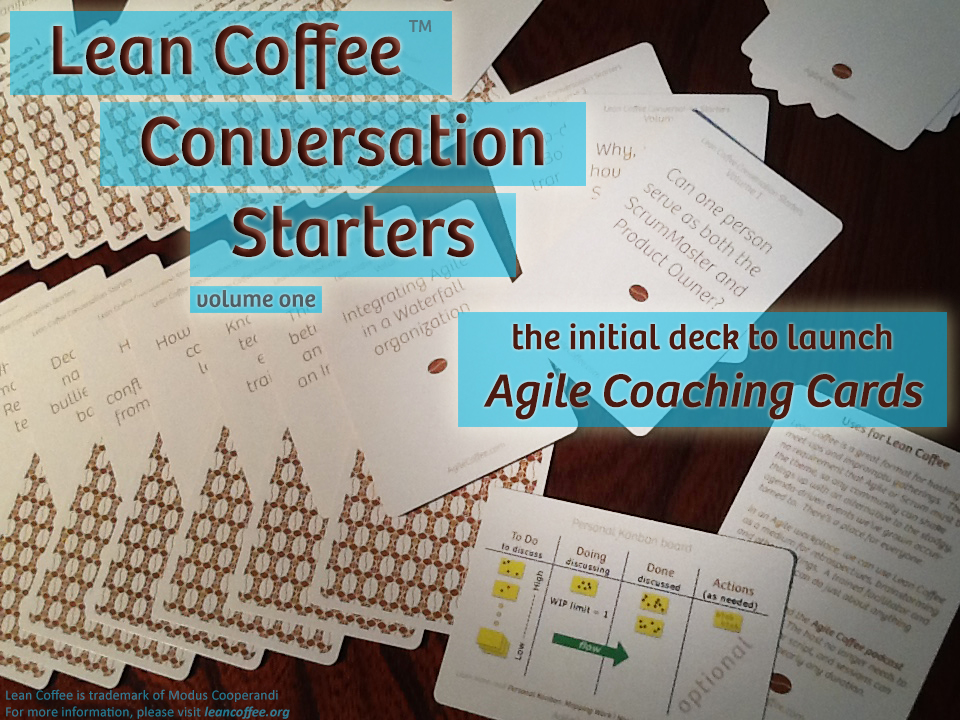
    Lean Coffee Conversation Starters, vol.1

    I’m extremely happy to announce that the campaign to produce these cards decks has officially begun on Kickstarer. As of today, the doors are opened for anyone to examine these products and support their production.

  • 30. Agile Community Events on the Beach

    Theme: Agile Community Events

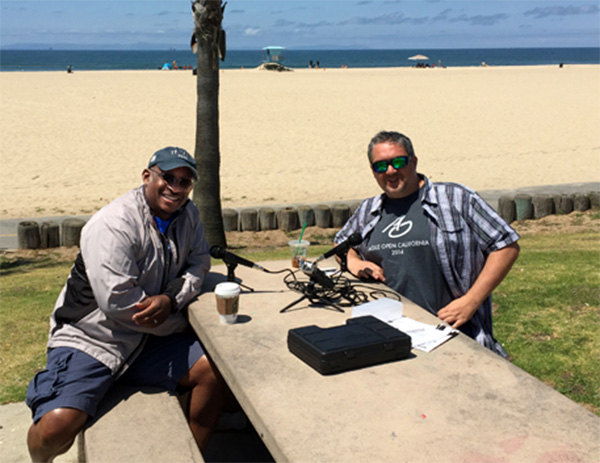
    on the beach with Dr. DaveDr. Dave (@DrCorneliusInfo) joins Vic (@AgileCoffee) for a beautiful morning on Huntington Beach discussing all manner of Agile community events: Agile Opens (and other open space uses), coaching retreats and camps, lean coffees, hackathons. Dave talks about the 5Saturdays model, and we tell how to find, get involved and host these activities.

    This is one of my favorite episodes. In addition to the excellent scenery and the superb company, I very much enjoy talking about community events. Not only do I believe that community is important and fulfilling, but I have a penchant for organizing these activities.

    For more information

    Open Space:

    Agile Opens:

    Agile Coach Camps:

    Scrum Coaching Retreat Seattle 2015

    LeanCoffee.org – includes listing of cities with lean coffees

    5Saturdays.org – Dr.Dave’s community learning initiative to bring Scrum and other skills into local high schools

    • ALICE – educational software that teaches computer programming in a 3D environment

    Scrum Day San Diego and Scrum Day Orange County (Vic presented at both in each of their first years)

    various others:

    Finally, Vic ran a couple of Hackathons in the workplace…

    – – – –

    Coming up in episode 31 – I hold a lean coffee at a 5Saturdays event with a cast of new voices.

    Further ahead in episode 32 – interviews from the 2nd annual Scrum Day San Diego.


  • 29. Frederic Laloux and Dr. Clare Graves Walk into a Bar

    Announcing the brand new Podcast Topic Index. Search and sort to find any topic discussed on our podcasts.


    Victor is once again joined by Dale Ellis (@theDigitalDale), Jason Kerney (@JasonKerney), Zach Bonaker (@ZachBonaker) and Garrett Borunda (LinkedIn) at the Cape Rey in Carlsbad for a lively morning of Agile and Coffee.

    In this episode, our Agile heroes discuss:

    Reach out to Vic (@AgileCoffee) and use the hashtag #tellAgileCoffee to interact with us on an upcoming episode.

    announcements:

  • 28. “Agile” Under the Microscope

    Victor is joined by Dale Ellis (@theDigitalDale), Jason Kerney (@JasonKerney), Zach Bonaker (@ZachBonaker) and Garrett Borunda (LinkedIn) at the Cape Rey in Carlsbad for a lively morning of Agile and Coffee.

    In this episode, our Agile heroes discuss:

    ACCUSWest 2015 archive at AgileLib.net, courtesy of Tobias Mayer

    Coming soon is Dr. Dave‘s 5 Saturdays program’s Train the Facilitators workshops: May 30th and June 6th. More info at 5Saturdays.org

    Reach out to Vic (@AgileCoffee) on Twitter and use the hashtag #tellAgileCoffee to interact with us on an upcoming episode.

  • 26. Visiting the Agile Open Northwest

    This episode is composed of two separate sessions. The first part was recorded on location at the 9th Annual Agile Open Northwest (Portland, OR) with Ben Sherwood, Michael Wolf, Alicia Lanier and Ian Savage.  For the second part, I returned to the home studio and was joined by Dale Ellis, Jon Jorgensen, Brett Palmer and Larry Lawhead.

    Between the two sessions, we dove deep into the following topics:

    1. Facilitation Tools – Groupwork cards
    2. Adaptive Action and Agile – aka What? So what? Now what?

    One more huge shout of gratitude to Ian, Alicia, Michael and Ben, to Diana, Tündér, Ainsley and all participants and volunteers at #AONW.

  • 24. How to Budget for Agile Software Development

    Vic is joined by Brett Palmer (@brett_palmer), Jon Jorgensen (@waterscrumban) and Larry Lawhead (@LarryLawhead) for a lively morning of Agile and coffee.

    Today our heroes discuss the following topics:

    • Agile Budgeting – Larry lent his copy of Agile Estimating and Planning to his CEO. Will he get it back?
    • The power of Standing for Agile – getting the team to arise
    • Mike Lavery (@baconPhilosophy) asks about tips for moderating the initial Product Backlog meeting
    • Framework Regression pain – when can a team create a circle of excellence?

    Want more? Visit our brand new forums on the AgileCoffee website.

    AgileGathering.com has the info about our upcoming Agile Coach Camp US West, April 10-12, 2015

  • Kafka, Agile Coach

    At the latest lean coffee, we had two cards with a similar question: how do you neutralize the bad apples / stop the eye-rolling? Later that night I remembered something I thought might apply, so below I try to craft it into a parable.

    (This post offers a huge tip of the hat to Robert Anton Wilson whose first chapter of “Quantum Psychology” describes a similar “parable about [this] parable”. Chapter nine of “The Trial” by Franz Kafka includes this central tale which Wilson treats as zen koan.)


    There was once a young scrummaster who had achieved some early success. His new team, however, offered only resistance to his words. Throughout his first two sprints he employed many methods to convince or cajole the team to change their perspective and accept agile / scrum. He offered empathy, used silence and questioning, provided studies and “facts” to support his claims. The scrummaster grew impatient and threatened the team, but they simply laughed him off.

    Finally he swallowed his pride and approached the agile coach. She offered the scrummaster a cup of tea.

    “This team is impossible!” the scrummaster exclaimed. “Why won’t they buy-in?”

    “Let me tell you a story,” the coach offered. After sipping her tea, she began:

    A man from the countryside comes up to the door of the Law, guarded by a doorkeeper, and asks for entry. The doorkeeper says he can’t let him in to the law right now. The man thinks about this, and then he asks if he’ll be able to go in later on.

    ‘That’s possible,’ says the doorkeeper, ‘but not now’.

    The man waits and grows older. Any time he asks, the doorkeeper rebukes him. The man offers bribes to this doorkeeper, and the guard accepts each offer saying as he pockets the money ‘I’ll only accept this so that you don’t think there’s anything you’ve failed to do’. Still, the man is not allowed entry.

    Over many years, the man tries time and again to get inside. In the first few years he curses his unhappy condition out loud, but later, as he becomes old, he just grumbles to himself. He becomes senile…

    Finally his eyes grow dim, and he knows doesn’t have much longer to live. In the moment before he dies, he brings together all his experience from all this time into one question which he has still never put to the doorkeeper…

    ‘Everyone wants access to the law,’ says the man, ‘how come, over all these years, no-one but me has asked to be let in?’

    The doorkeeper can see the man is near death. ‘Nobody else could have got in this way, as this entrance was meant only for you. Now I’ll close it forever’. As the door is slammed shut, the man expires.

    The scrummaster all but spits out his tea. “He died?” “Indeed,” the coach assured.

    Another sprint passes, and the scrummaster returns to the agile coach, finding her in the lounge outside her office.

    “I’ve considered this story from many angles, and I have questions. If the door existed only for this man, why was he not allowed to enter? Why was the door left tantalizingly open? Why did the guard close the door only when the man was too old and weak to enter?”

    As the coach poured two cups of tea, the scrummaster continued. “Am I the man in this parable? Is my team the majesty beyond the door? Who is the doorkeeper?” Ignoring his tea, the scrummaster implored “Please. Explain to me the lesson of this dark parable.”

    “I will explain it to you,” the coach promised, “if you follow me into my office.”

    The coach stepped into the room, quickly turned, and slammed the door in the scrummaster’s face.

    At that moment, the scrummaster experienced enlightenment.
  • Roadmapping with Coffee and Hats

    Does your IT organization make a practice of yearly roadmapping? Mine does. The current shop, the previous one, the one before that, and on and on. Just about every technology department I’ve been a part of does some form of yearly roadmapping exercise. The one characteristic that they all share? They’re drudgery.

    The process of creating a roadmap seems a staple of the yearly business cycle, but that doesn’t mean that it has to suck. I work with technology folks who, independent of the sales pipeline, are asked to list, size and prioritize some set of initiatives that are either wanted (eg. trying out a new language) or needed (eg. addressing tech debt) by the engineering departments. It’s a noble goal, making developers’ lives better by helping them get their environments free of impediments.

    Problem is: no one looks forward to the planning sessions. When I try to recruit participants (usually a subset of architects, team leads, etc.) for a roadmap planning session, everyone spontaneously seizes up and/or runs from the room.

    When my boss asked me to coordinate this latest series of roadmap discovery and prioritization, I replaced the standard “sit around the table and gripe” sessions with two alternatives: Lean Coffee and Six Thinking Hats.

    I invited the team to what I called a “planning coffee”, and curiosity took over. When the dozen-or-so members arrived, they saw an inviting table with index cards, markers and coffee carafes (optional). We made chit chat until enough people were there to begin (we did not wait for or worry about the stragglers). A quick explanation of the coffee rules, and we were off writing our wishlist items onto 3×5 cards. People got out of their chairs – their brains getting more oxygen than when they all just sit around – and the mood remained light.

    Affinity mapping the cards is a fantastic cue for glimpsing the importance of a topic, but we still did some dot-voting after each topic card (or group of cards) was summarized. If we ended the meeting at this point, we would’ve already collected more information transparently and asynchronously in under ten minutes than we could have hoped for in a two-hour session going around the table with each representative speaking up in turn. Still, we played out the hour-long event asking questions of and examining the top few topics.

    After the “meeting”, I took these data (topics cards, votes, added explanations) and compiled them onto a shared document. Others people throughout Engineering were free to read this and add or update as they like. Visibility makes the process much easier.

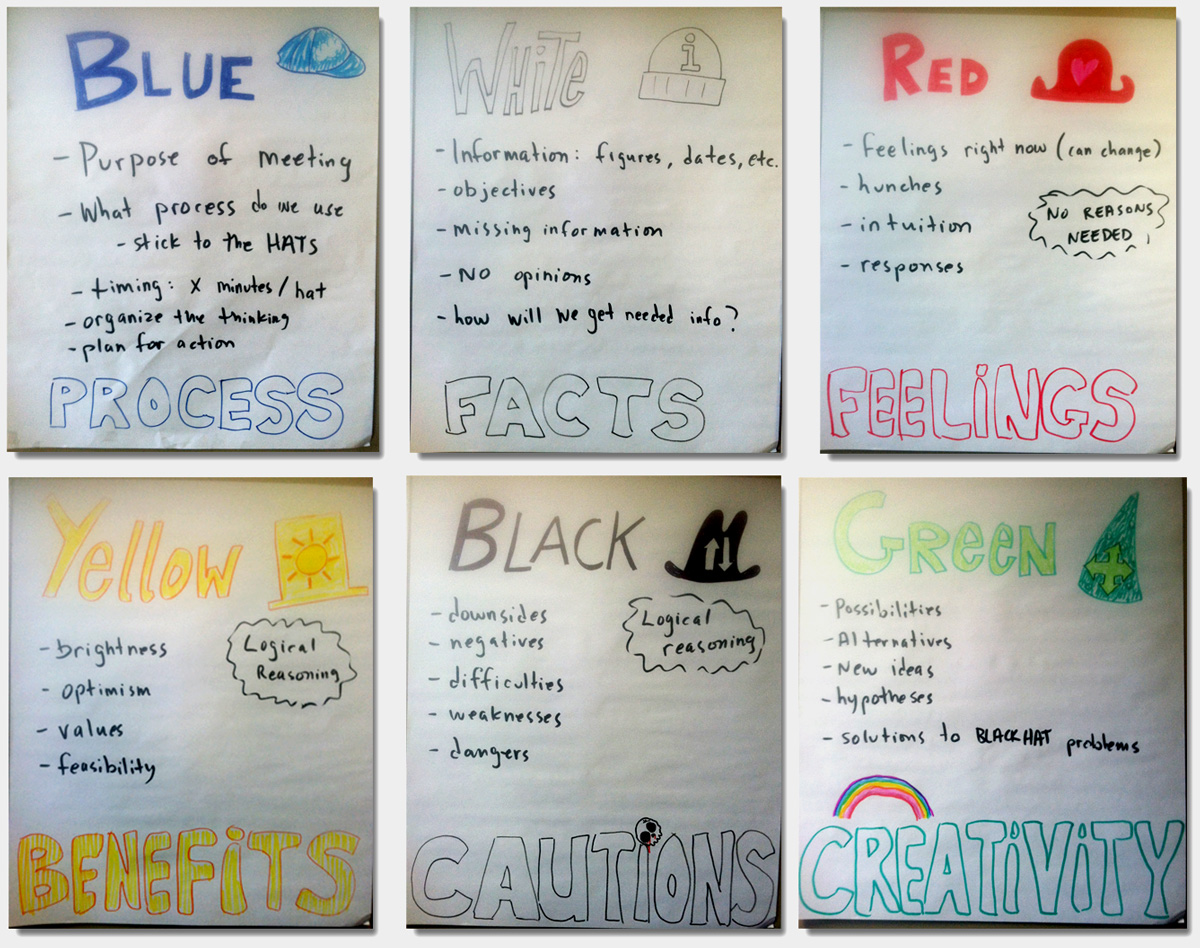
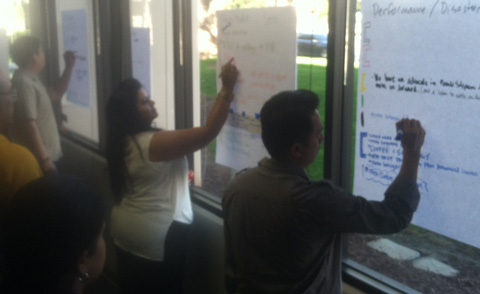
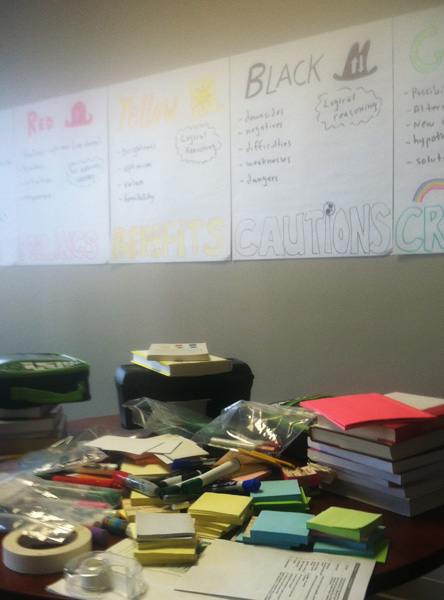
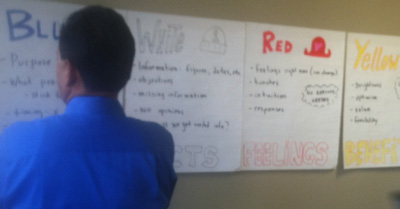
    For the next round (with roadmapping, there’s always a next round) I brought together the whole department in a large open space with no tables. On the walls I’d hung 14 easel-pad sheets of paper – eight representing the top eight issues that came out of the prior “planning coffee”, and one poster of each of DeBono’s Six Thinking Hats. After quick explanation of the goal (to add ideas & insights to the list of prioritized roadmap items), we had everyone form groups (counting off 1 thru 8 helped randomize & balance the teams) and move to one of the eight stations.

    hats-6

    Each team spent about five minutes at each station, working through each of the six hats at every stop. They recorded their ideas onto the large paper with markers, then moved on to the next topic paper. At the end of the session, we had fantastic data and suggestions on every one of our top eight roadmap items.

    The Six Hats exercise added greater dimension to the department’s wishlist than a room full of mandatory attendees ever could have. The CTO appreciated that the entire exercise was kept to two one-hour meetings (as opposed to multiple days spread out over a few weeks), and she knows that the department “owns” (has defined and is accountable for) this list. It makes her job of negotiating with other management much easier.

    hats-ahats-chats-b