Victor Bonacci

  • Roadmapping with Coffee and Hats

    Does your IT organization make a practice of yearly roadmapping? Mine does. The current shop, the previous one, the one before that, and on and on. Just about every technology department I’ve been a part of does some form of yearly roadmapping exercise. The one characteristic that they all share? They’re drudgery.

    The process of creating a roadmap seems a staple of the yearly business cycle, but that doesn’t mean that it has to suck. I work with technology folks who, independent of the sales pipeline, are asked to list, size and prioritize some set of initiatives that are either wanted (eg. trying out a new language) or needed (eg. addressing tech debt) by the engineering departments. It’s a noble goal, making developers’ lives better by helping them get their environments free of impediments.

    Problem is: no one looks forward to the planning sessions. When I try to recruit participants (usually a subset of architects, team leads, etc.) for a roadmap planning session, everyone spontaneously seizes up and/or runs from the room.

    When my boss asked me to coordinate this latest series of roadmap discovery and prioritization, I replaced the standard “sit around the table and gripe” sessions with two alternatives: Lean Coffee and Six Thinking Hats.

    I invited the team to what I called a “planning coffee”, and curiosity took over. When the dozen-or-so members arrived, they saw an inviting table with index cards, markers and coffee carafes (optional). We made chit chat until enough people were there to begin (we did not wait for or worry about the stragglers). A quick explanation of the coffee rules, and we were off writing our wishlist items onto 3×5 cards. People got out of their chairs – their brains getting more oxygen than when they all just sit around – and the mood remained light.

    Affinity mapping the cards is a fantastic cue for glimpsing the importance of a topic, but we still did some dot-voting after each topic card (or group of cards) was summarized. If we ended the meeting at this point, we would’ve already collected more information transparently and asynchronously in under ten minutes than we could have hoped for in a two-hour session going around the table with each representative speaking up in turn. Still, we played out the hour-long event asking questions of and examining the top few topics.

    After the “meeting”, I took these data (topics cards, votes, added explanations) and compiled them onto a shared document. Others people throughout Engineering were free to read this and add or update as they like. Visibility makes the process much easier.

    For the next round (with roadmapping, there’s always a next round) I brought together the whole department in a large open space with no tables. On the walls I’d hung 14 easel-pad sheets of paper – eight representing the top eight issues that came out of the prior “planning coffee”, and one poster of each of DeBono’s Six Thinking Hats. After quick explanation of the goal (to add ideas & insights to the list of prioritized roadmap items), we had everyone form groups (counting off 1 thru 8 helped randomize & balance the teams) and move to one of the eight stations.
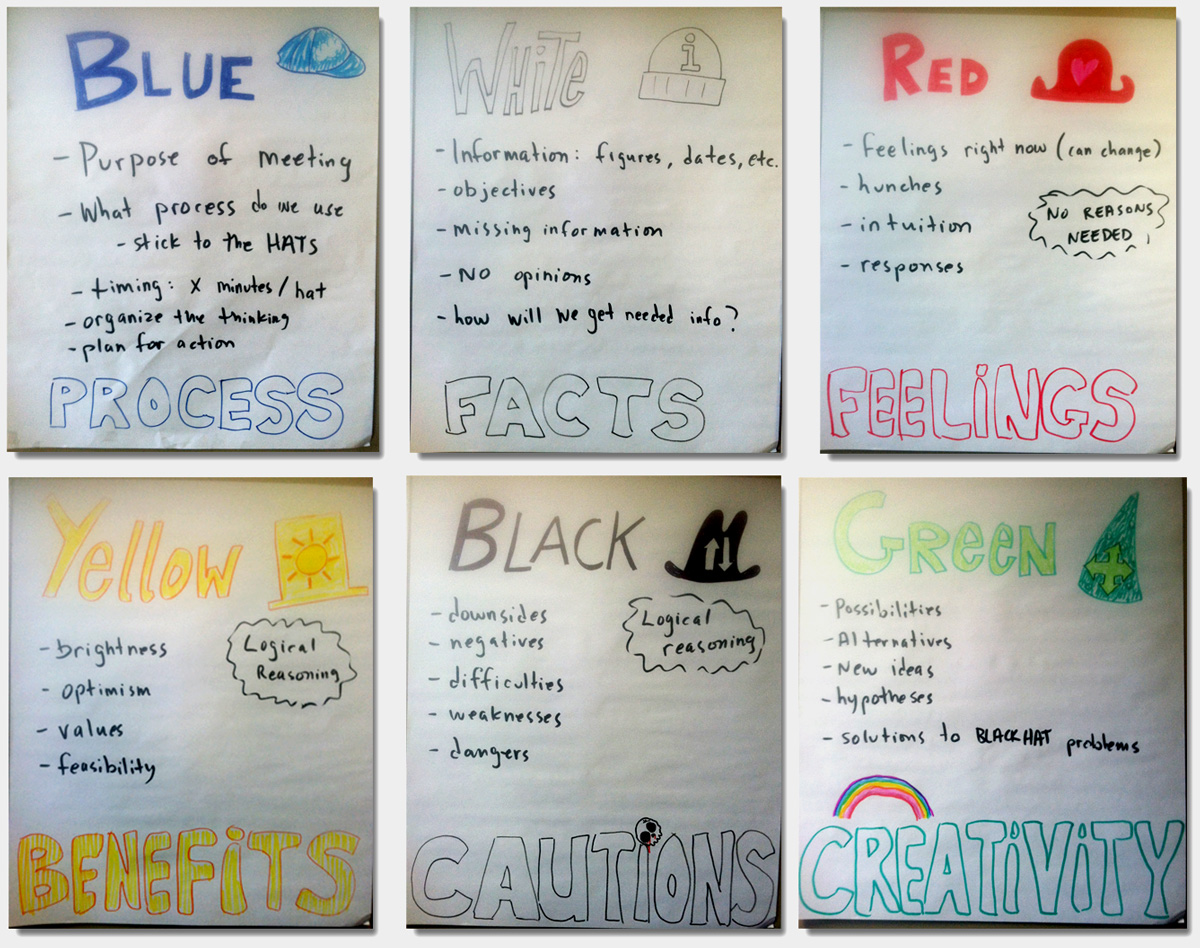
    hats-6

    Each team spent about five minutes at each station, working through each of the six hats at every stop. They recorded their ideas onto the large paper with markers, then moved on to the next topic paper. At the end of the session, we had fantastic data and suggestions on every one of our top eight roadmap items.

    The Six Hats exercise added greater dimension to the department’s wishlist than a room full of mandatory attendees ever could have. The CTO appreciated that the entire exercise was kept to two one-hour meetings (as opposed to multiple days spread out over a few weeks), and she knows that the department “owns” (has defined and is accountable for) this list. It makes her job of negotiating with other management much easier.
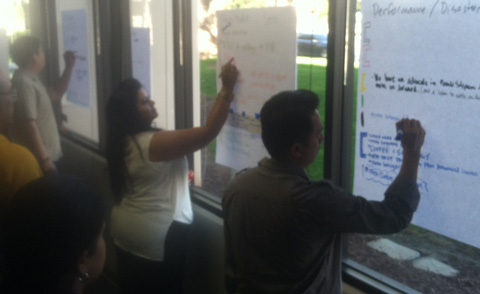
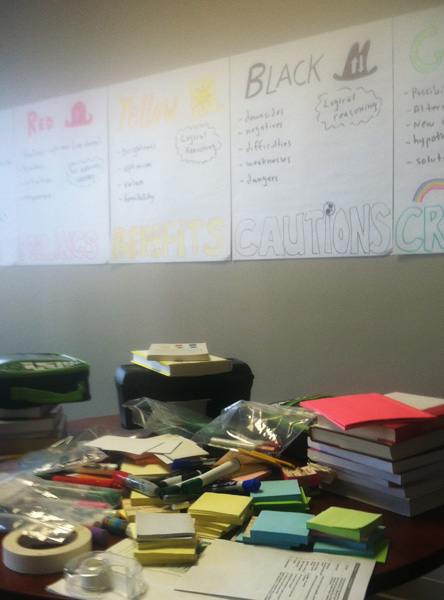
    hats-ahats-chats-b

  • 20. Our Twentieth Coffee on the Record

    This just in! We’re announcing that Vic will serve as facilitator for the upcoming Coach Camp. To learn more and see who will be attending, point your browser to AgileGathering.com for all the info about Agile Coach Camp US West, April 10-12, 2015

    For this episode, Vic is joined by Jon Jorgensen (@WaterScrumBan) and Dale Ellis (@thedigitaldale) for a lively morning of Agile and coffee.

    Today our heroes discuss the following topics:

    • Offshoring Wisdom – is this practice achieving its objective of lowering the organization’s development costs?
    • Tenure and Great Teams – How can we retain our people? How long does it take for a coach to affect change?
    • New Meeting Methods – Dale mentions Dick and Emily Axelrod’s “Let’s Stop Meeting Like This
    • Paired Coaching and Approximating Truth – Vic gave Jon a copy of “Quantum Psychology” (Robert Anton Wilson) as a Christmas gift, and it got Jon thinking.

    Want more? Visit our brand new forums on the AgileCoffee website.

    BTW, have you gone to iTunes or Stitcher to give us a review? It takes so little time and would sure help us a lot. Thanks!

    Reach out to Victor (@AgileCoffee) on Twitter –  and use the hashtags #askAgileCoffee or #tellAgileCoffee to interact with us on an upcoming episode.

  • 19. When Jon and Brett Came Back with Tapes

    For this episode, Jon (@WaterScrumBan) and Brett (@brett_palmer) find themselves reminiscing about their trip to Indianapolis for Agile Coach Camp last September 26-28, 2014. There they met Bryan Beecham (@BillyGarnet) of Iceberg Ideas and Mike Bowler (@Mike_Bowler) to discuss the following topics:

    Bryan will be joining us at the upcoming Agile Coach Camp in Irvine, April 10-12. Will you? More info at AgileGathering.com.

    Have you visited our forums on the AgileCoffee website?

    Reach out to Victor (@AgileCoffee) on Twitter –  and use the hashtags #askAgileCoffee or #tellAgileCoffee to interact with us on an upcoming episode.

  • Lean Coffee in the workplace

    Recently I was asked about using Lean Coffee (LC) in the workplace, something I’ve been doing for the past few years. While I’m a strong advocate for LC’s workplace applications, I’d like to start with my view of the broader picture. (I’ve written about my experiences with LC before, but this post has more experiences to back it up.)

    I’d originally heard about Lean Coffee three years ago when I met Jim Benson at SFAgile2012. I immediately fell in love with the framework, so much so that I switched my twitter handle to @AgileCoffee.  Once I returned from the conference, I started a bi-weekly Lean Coffee here in Orange County, CA, that still meets regularly. (By the way, I’ve got nothing but love for Jim & Jeremy and the leancoffee.org website. I credit them often and drive traffic to their site, all so I can help shout about LC from the rooftops. So many potential applications, IMO.)

    For the community LCs that I run (and I’m all about community), I use meetup.com to get the word out and organize. It costs a bit of money out of my own pocket, but the payback has been amazing. We’ve had an Agile/XP community here for many years – mostly project managers and technologists showing up to monthly workshops out of habit to eat pizza – by and large, those events (while useful) aren’t very exciting. The LCs, on the other hand, draw a subset of non-zombiefied practitioners as well as students and entrepreneurs who find us via meetup. I’ve been holding these for nearly three years now, but rarely have co-workers come by to participate.

    A recent spin-off of the community meetups is the podcast. Some of the regular visitors to the meetups agreed that the conversations were often too valuable/entertaining to let fade away, so we began holding separate sessions to be recorded (and published to Stitcher and iTunes). It was an easy transition, and we follow the LC format in real time on each episode. (In the earliest episodes I explained the rules, not so much these days.) These have allowed us to share the conversations around the globe. As of this writing, we have about 240 downloads per session with a few questions & comments coming from these. 18 episodes produced so far, three more in the pipeline, and our next recording meetup in a week. All recording sessions for the podcast are held in person – I’m resisting the temptation to do a LC by Skype or Google hangout, mostly because I believe face-to-face is the only way to do a LC.

    When I go to conferences and Open Space events, I carry a kit filled with index cards, sharpies and some blue tape. Impromptu LCs can spin up in no time at all. (An interesting aside: I’ve kept nearly all the (anonymous) index cards from my meetups, podcast sessions and impromptu LCs for a few years now. Someday I hope to index, group and share them. Not sure how or why, but I enjoy seeing questions repeated or themes forming over time.)

    I also get invited to speak locally/regionally about LC and the benefits for using them in the workplace. For each presentation, I use a slide deck I created so I can put LCs into context before holding mini-coffees with large groups. (This year, I created a pecha-kucha for the Scrum Alliance gathering in Phoenix … crossing my fingers to get accepted.) We also were talking a year ago about trying a Scaled Agile Coffee TM (aka really big LC), but realized that Agile Opens and Agile Coach Camps are pretty much what we had in mind. (We’re hosting the next ACCUS here in Irvine in a couple months.)

    Okay, so with regard to the workplace…

    It didn’t take too long after starting the community LCs before I wanted to experiment with them at work. Back then I was a coach/SM at SendGrid, and I was always looking for alternative experiences for the retrospectives. The first time I ran a LC, the quick reaction was “WTF?”  The team was used to me trying different techniques, but this one caught them off guard somehow. By the time the session timebox expired, they (almost) didn’t want to leave the room. We’d discovered together how some topics – previously given lip-service at prior retros – were actually important and complex enough that they dominated a 90-minute session. More cards were created mid-coffee, and we were surprised that even the normally quiet and reserved members became vocal. (I think it was as much about getting them out of their comfort zone as much as it was about the LC format itself, but… winning!)

    A year ago I attended a workshop on retrospectives led by Diana Larsen. I’d brought up LCs as an alternative technique, and the room exploded. Other folks there had previously employed it, to equally dramatic results. I’ve found, though, that I can’t use it on a regular cadence with my teams. I like to spring it on teams when they least expect it, otherwise it could turn into one large bitch session.

    It’s a great format for brainstorming activities, as you likely know. Not so good for ordering / prioritizing work or detailing technical concepts, though.

    I’ve used LC with my Scrummasters. SendGrid had 10-12 teams spread across four locations when I left, with about five full-time SMs who self-organized to share “best practices” (I use the term loosely). When we were able to be together in person, I would carve out time for a SM-focussed LC so we could address common concerns and brainstorm new activities. We’d even tried to hold a SoS as a LC, but it wasn’t too successful. Oh well, we tried.

    Now I’m at another workplace, and I use LC more than ever. I still keep it as a retro technique, but I’ve also introduced it to managers and executives. When my boss asked me to organize the ritual yearly Roadmap exercise, I shocked the system by holding a LC in the boardroom. Defenses came down when we affinity mapped the cards into topics and found overwhelming support for issues related to tech debt, stability and scaling our services. Suddenly pie-in-the-sky features didn’t seem nearly as urgent to the C-levels present. Although later meetings were more traditional, the LC exercise cut right to the meat of what would become our highest priority objectives for the year. Saved time with a lot less arguing and horse-trading than I’d experienced with similar roadmapping cycles at previous organizations.

    Over the holidays, a peer/mentor of mine pushed me to try to find more applications of this lightweight, agenda-less model in the workplace. It really is my laboratory, and LC is a fantastically easy and effective format to throw at unsuspecting participants.

    I’d like to discover more uses of Lean Coffee. If you have other applications, please share in the comments below or to me via twitter @AgileCoffee.

    – – – –

    Update 2/25/15: I wrote a guest post on the Modus Cooperandi blog entitled Fresh Perspectives on Lean Coffee where I go into a bit more detail on the roadmapping exercise. I’ve also dedicated an entire post on Roadmapping with lean coffee and Edward De Bono’s Six Thinking Hats. Enjoy!

  • 18. Agile in the Hundred Acre Woods

    Say, have you gone to iTunes or Stitcher to give us a review? It takes so little time and would sure help us a lot. Thanks!

    For this episode, Vic and Jon are joined by Larry Lawhead (lawhead5@hotmail.com), Dale Ellis (@thedigitaldale) and Brett Palmer (@brett_palmer) for quick and efficient morning of Agile and coffee.

    Today our heroes discuss the following topics:

    • Dale started things off telling us about Pooh Camp, Disney’s take on O’Reilly’s Foo Camp. This inspired questions and conversation from Brett, Jon and I (organizers of this year’s ACCUC in California).
    • Does UAT have value for Scrum teams?
    • Time-boxing elaboration and requirements discussions
    • Ten Deployments a day?
    • Mobile Build frequency

    Want more? Visit our brand new forums on the AgileCoffee website.

    AgileGathering.com has the info about our upcoming Agile Coach Camp US West, April 10-12, 2015

    Reach out to Victor (@AgileCoffee) and Jon (@WaterScrumBan) on Twitter –  and use the hashtags #askAgileCoffee or #tellAgileCoffee to interact with us on an upcoming episode.

  • 17. ‘Tis the Season for Lean Coffee

    Before we begin… have you gone to iTunes or Stitcher to give us a review? It takes so little time and would sure help us a lot. Thanks!

    New:

    For this episode, Vic and Jon are joined by Larry Lawhead (lawhead5@hotmail.com), Dale Ellis (@thedigitaldale) and Brett Palmer (@brett_palmer) for peaceful morning of Agile and coffee.

    Today our heroes discuss the following topics:

    Reach out to Vic (@AgileCoffee) and Jon (@WaterScrumBan) on Twitter –  and use the hashtags #askAgileCoffee or #tellAgileCoffee to interact with us on an upcoming episode.

  • 16. Do Agile Methods work with ERP Projects?

    Vic is joined by returning guest Dale Ellis (@theDigitalDale) and newcomer Alberto Hernandez for a fresh brew of Agile topics:

    • “Death March” Scrum and Kanban – Dale bases this question on Edward Yourdon’s “Death March
    • How can ERP implementations be sped up using Agile methodologies? – Alberto has much experience with ERP rollouts but wants to know how they can improve
    • Internal Hackathons – Vic talks about running a four-day coding event inside his company

    Announcing Agile Coach Camp US West. For the first time on the US west coast (and only the sixth time in the USA), Agile Coach Camp is coming to Irvine, California, from April 10-12, 2015. Organized by yours truly, this multi-day “unconference for Agile coaches” will be set amidst the bunkhouses and hiking trails of the Irvine Ranch Outdoor Education Center. We guarantee your fill of ‘smores around the campfire. Be sure to visit AgileGathering.com to find out more information.

    Finally, regular listeners remember Dr. Dave Cornelius (@DrCorneliusInfo) whose 5 Saturdays program introduces teens to Scrum practices and other skills to build a career on. Visit 5Saturdays.org to learn more and support Dr. Dave’s work.

  • 15. A Great Day for Agile, a Great Day for Coffee

    For this episode, Vic and Jon are joined by Dale Ellis, Larry Lawhead and Dr. Dave Cornelius (@DrCorneliusInfo) in an undisclosed location for a lively morning of Agile and Coffee.

    In this episode, our Agile heroes discuss the following topics:

    • having fun with self-organizing teams – we mentioned Game Changers and Mike Bonifer’s ERGO framework
    • organizing daily meetings with kanban – ever heard of chorei or asakai? Neither did I. We discussed Dave Anderson (Microsoft) and “walking the board”
    • voting when you can’t see eachother – Larry introduced another timely topic
    • long-term value of a coach / scrummaster – Dr. Dave talks about our role after the team becomes self-managing

    We offer our thanks to Gene Kim (@RealGeneKim) for giving us copies of The Phoenix Project to give to you. Listen to the episode to find out how.

    Also we want to congratulate Dr. Dave for the success of his 5 Saturdays program. Check out the progress at 5Saturdays.org

    Reach out to Jon (@waterScrumBan) and Vic (@AgileCoffee) on Twitter –  and use the hashtags #askAgileCoffee or #tellAgileCoffee to interact with us on an upcoming episode.

  • 14. What is Core Scrum?

    Vic and Jon are joined by Larry Lawhead (lawhead5@hotmail.com) and Dale Ellis (@thedigitaldale) for peaceful morning of Agile and coffee.

    In this episode, our heroes discuss the following topics:

    • upcoming Agile conferences
    • self-help in free software
    • core scrum
    • TDD takes 2x as long?

    Reach out to Vic (@AgileCoffee) and Jon (@WaterScrumBan) on Twitter –  and use the hashtags #askAgileCoffee or #tellAgileCoffee to interact with us on an upcoming episode.

  • 13. Not an Unlucky Session, Not At All

    Superstitious? Maybe. But for this brew Vic and Jon are joined by Dale Ellis (@thedigitaldale) and Larry Lawhead (lawhead5@hotmail.com) for peaceful morning of Agile and Coffee.

    In this episode, our heroes discuss the following topics:

    1. Estimating 2.0
      • (photo forthcoming…)
      • four categories for stories: no progress, sizeable, spike, emergeable
      • product mentioned: Time Cube
    2. How is Scrum used in Construction
      • referred to pg.82 of Jeff Sutherland’s upcoming book “@AgileCoffee) and Jon (@WaterScrumBan) on Twitter –  and use the hashtags #askAgileCoffee or #tellAgileCoffee to interact with us on an upcoming episode.