In this episode, our heroes discuss the following topics:
upcoming Agile conferences
self-help in free software
core scrum
TDD takes 2x as long?
Reach out to Vic (@AgileCoffee) and Jon (@WaterScrumBan) on Twitter – and use the hashtags #askAgileCoffee or #tellAgileCoffee to interact with us on an upcoming episode.
Superstitious? Maybe. But for this brew Vic and Jon are joined by Dale Ellis (@thedigitaldale) and Larry Lawhead (lawhead5@hotmail.com) for peaceful morning of Agile and Coffee.
In this episode, our heroes discuss the following topics:
Estimating 2.0
(photo forthcoming…)
four categories for stories: no progress, sizeable, spike, emergeable
product mentioned: Time Cube
How is Scrum used in Construction
referred to pg.82 of Jeff Sutherland’s upcoming book “@AgileCoffee) and Jon (@WaterScrumBan) on Twitter – and use the hashtags #askAgileCoffee or #tellAgileCoffee to interact with us on an upcoming episode.
Jon and Vic are joined by Dr. Dave Cornelius (@DrCorneliusInfo) in an undisclosed location for a lively morning of Agile and Coffee.
In this episode, our Agile heroes discuss the following topics:
Culture as the Silent Killer
Deliver Fast
Flex Training
Reach out to Jon (@waterScrumBan) and Vic (@AgileCoffee) on Twitter – and use the hashtags #askAgileCoffee or #tellAgileCoffee to interact with us on an upcoming episode.
Jon and Vic are joined by Dr. Dave Cornelius (@DrCorneliusInfo) and Brett Palmer (@Brett_Palmer) in an undisclosed location for a lively morning of Agile and Coffee.
In this episode, our Agile heroes discuss the following topics:
Wisdom of crowds
Respect people
First week on the job
Training Conquest
Coaching retreats / bootcamps
Reach out to Jon (@waterScrumBan) and Vic (@AgileCoffee) on Twitter – and use the hashtags #askAgileCoffee or #tellAgileCoffee to interact with us on an upcoming episode.
The last installment of our final Paradise Perks session (you have to admit, the ambient noise could get loud). Recorded the day after their presentation at Scrum Day San Diego, Jon and Vic are joined by Dr. Dave Cornelius (@DrCorneliusInfo) and Brett Palmer (@Brett_Palmer) for a lively morning of Agile and Coffee. In this episode, our Agile heroes discuss the following topics:
Software development is not manufacturing
“Bat outta hell” syndrome
We ended with a quick retro on the event.
Reach out to Jon (@waterScrumBan) and Vic (@AgileCoffee) on Twitter – and use the hashtags #askAgileCoffee or #tellAgileCoffee to interact with us on an upcoming episode.
Part 2 of the Paradise Perks finale, Jon and Vic are joined by Dr. Dave Cornelius (@DrCorneliusInfo) and Brett Palmer (@Brett_Palmer) for a lively morning of Agile and Coffee.
It’s our last podcast from Paradise Perks in Irvine (alas, the institution has shuttered its doors), and this session (recorded on June 14th) is divided into three parts, all using the lean coffee format. In this episode, the Agile heroes discuss the following topics:
Zero QA – is QA really necessary?
Planned Serendipity – lean coffee format, and introducing Gangplank as an example of this
Enabling Innovation – the role of disruptive innovation in the workplace
Coaching Circles and the career path, measuring coach efficacy
Reach out to Jon (@waterScrumBan) and Vic (@AgileCoffee) on Twitter – and use the hashtags #askAgileCoffee or #tellAgileCoffee to interact with us on an upcoming episode.
Fresh off their Scrum Day San Diego appearance, Jon and Vic are joined by Dr. Dave Cornelius (@DrCorneliusInfo) and Brett Palmer (@Brett_Palmer) for a lively morning of Agile and Coffee.
It’s our last podcast from Paradise Perks in Irvine (alas, the institution has shuttered its doors), and this session (recorded on June 14th) is divided into three parts, all using the lean coffee format. In this episode, the Agile heroes discuss the following topics:
Culture eats what? Key Man syndrome and amoeba hump reverts
“Agile practies make me tired”
Two new uses for Agile Coffee: afterglows and cold-calling
Reach out to Jon (@waterScrumBan) and Vic (@AgileCoffee) on Twitter – and use the hashtags #askAgileCoffee or #tellAgileCoffee to interact with us on an upcoming episode.
[ UPDATE July 2016 – I no longer subscribe completely to the concept of capacity planning, at least to this level of detail. I will keep this post available, but I will not maintain the fancy spreadsheet 😉 It’s fun to geek out with numbers and formulas, but we could do better having meaningful conversations with our teams. ]
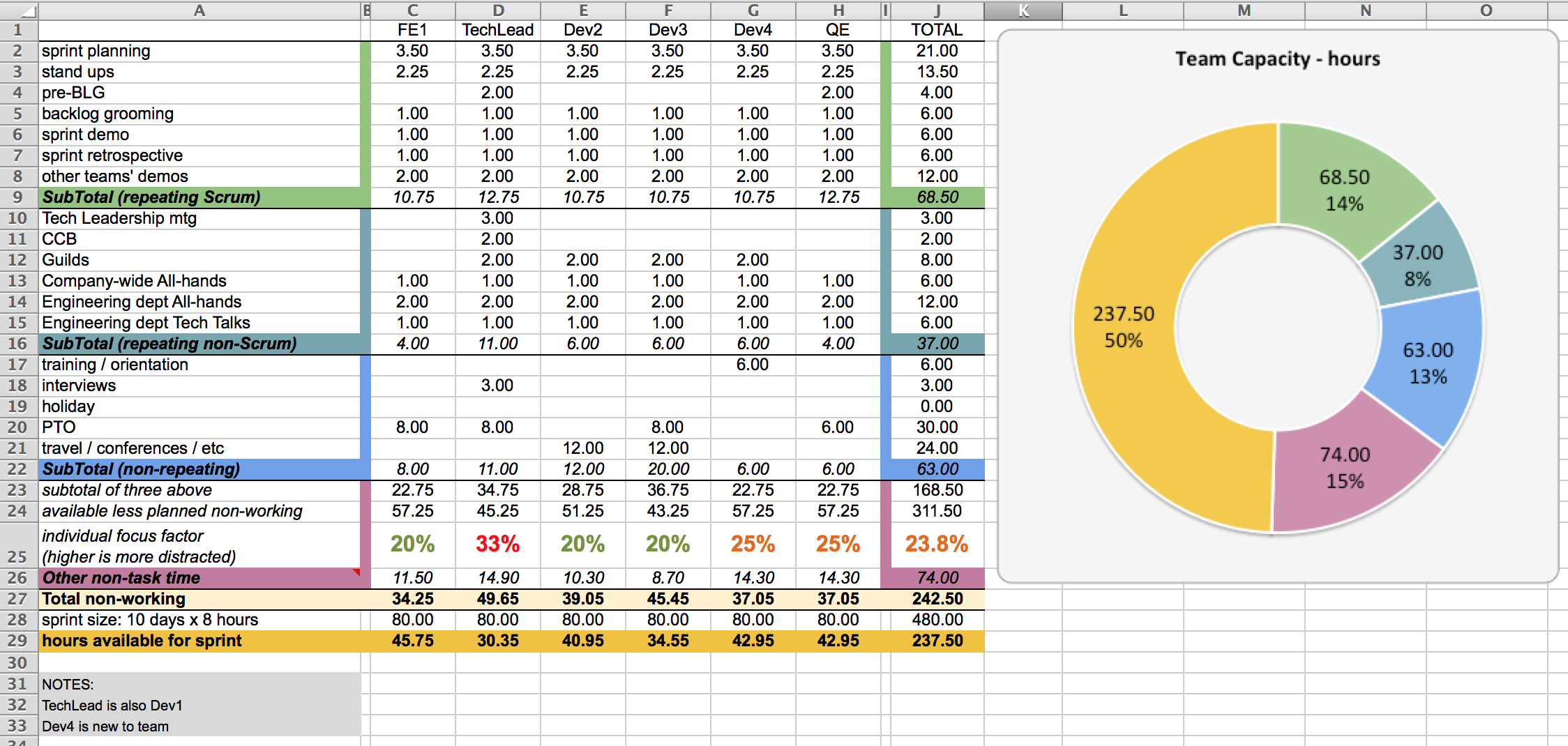
The topic of Capacity Planning came up in a recent coffee, and I decided to introduce it to my new team. I just developed a spreadsheet (illustration below) that helps make visible the number of hours that each team member is committed to for various activities not related to actual work on user stories and defects. The purpose for doing this was to make everyone aware of their overhead before they commit to a sprint.
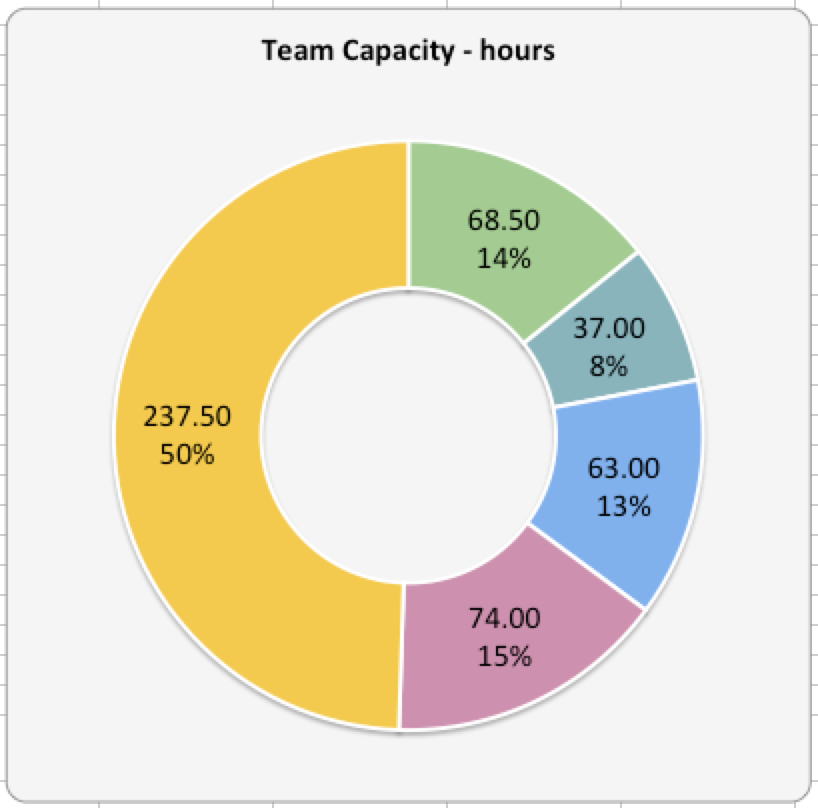
sample Capacity Planning worksheet for Scrum teams (with chart)
I was introduced to the concept of making capacity transparent at the start of each sprint when SendGrid did the initial Agile transformation. I was especially drawn to the focus factor (though we didn’t use that term at SG) which accounts for the hard-to-quantify time that an individual loses each day to tasks such as checking emails, impromptu discussions, unplanned meetings, helping teammates, etc. For focus factor, we plugged in a flat value of about 25% of each person’s day, but the more I consider it, I now prefer using a range (eg. from 15-30%) specific to each team member. This factor may also may change over time (eg. sprint to sprint or day to day).
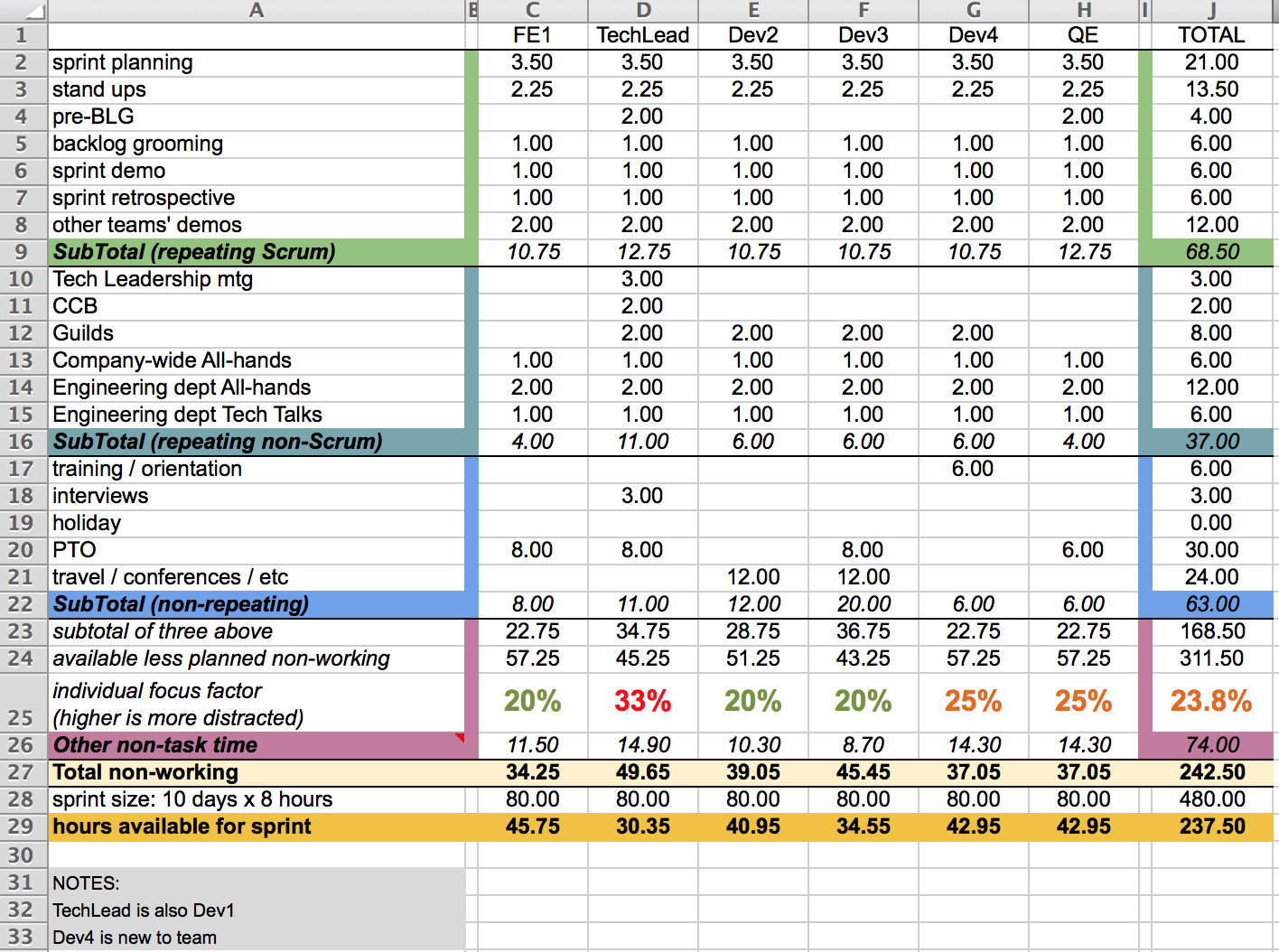
The hours in the worksheet (full size image below) are all based on a two-week sprint, so how many hours for activity x are consumed in 14 days.
sample Capacity Planning worksheet for Scrum teams (table)
I’m going to walk through the rows in some detail here:
Columns C – H represent six individual contributors on a Scrum team. The team’s Tech Lead attends more meetings and is interrupted more than other members. Dev4 is a new team member and is attending orientations and trainings.
Rows 2 – 8 are related to Scrum ceremonies that are repeating and predictable over the two-week sprint.
Rows 10 – 15 are related to non-Scrum activities scheduled by the company, department or guilds that are repeating and predictable over the two-week sprint.
Rows 17 – 21 are non-repeating and unpredictable. The ScrumMaster solicits each member’s hours in this category at the start of the Sprint Planning session.
Row 26 represents the unknown, unquantifiable “soup” that consumes our working days (described above). The focus factor (row 25) changes for each team member, and the higher the percent value, the more the member is expected to be distracted. This percent value is applied to the hours remaining outside of those already accounted for in the above three categories.
Row 27 is the sum (in hours) of each of the above four categories.
Note that (for this sample team) no account is made for any team members splitting their time between projects (eg. the FE developer is 100% allocated to this team). Also, the focus factor isn’t adjusted for multi-tasking between an unreasonable number of stories (ie. this model assumes an individual WIP limit of 1 or 2) with the possible exception of the Tech Lead.
[update 5/15/15] Here’s a download of the Team Capacity Worksheet (.xls). I offer this download with no guarantees that it will work on your OS, and I will not be updating it or converting it to other formats.